If you think entrepreneurs are a tough breed to figure out, imagine being married to one.
The life of an entrepreneurial wife (or husband) can be filled with tension, uncertainty, hard work and loneliness. That’s all forgotten when the business succeeds and they start buying the brand-name scotch, but it’s a tiring, roller-coaster ride while it lasts.
Remind me to tell you about the roundtable I held at PROFIT Magazine a few years ago, when we gathered some wives of local young entrepreneurs to spill the beans on what life at the centre of the whirlwind is really like. It’s not as easy as it looks.
In the meantime, Laura Bailey of Crain's Detroit Business magazine wrote a story in November 2003 on the hectic lives of entrepreneurs’ spouses. The story itself is beyond the pay wall here, but it makes some great points:
* Robert Dube, owner of Oak Park-based Image One Corp., and his wife, Emily, are so busy they have to schedule a special weekly lunch to discuss family issues.
* "It's almost like there's a third party in your marriage,'' said Melanie Zauel, whose husband, Brian, co-owns Wixom-based Cornerstone Engineering, a full-service architectural firm that today has 19 employees. "Sometimes all of his energy is used up in work, and there isn't anything left for the rest of the family.''
(Not that she’s complaining. "I wouldn't want to be married to somebody who is miserable because he is working for somebody else,'' she added. )
* Work-life balance is one of the biggest concerns for entrepreneurs, and often it's up to the spouse to keep that harmony.
* Another issue that entrepreneurs grapple with is finances. Money provides ammunition for fights in any marriage, but for entrepreneurs it's worse.
"There's not a person in the (Young Entrepreneurs Organization) that does not have their house and personal assets on the line,'' said Tom Nardone, president of Isdera Corp… YEO is a support group and networking organization for entrepreneurs under age 40 with $1 million or more in annual revenue, and Nardone said work-family balance is the group's biggest issue.
* And don't think the husbands of business owners get off easy. “I maybe do some things (around the house) that some of my friends don't do,'' such as more laundry or evenly dividing the household chores, said David Cattermole, senior design engineer for Troy-based Compunetics Inc. He is married to Laura Cattermole, founder of Farmington-based IT staffing company RemTech Business Solutions. For example, he cooks and she washes or vice versa.
"We're a team,'' says David.
Tuesday, April 18, 2006


Wednesday, April 12, 2006
The Entrepreneur’s Family
I just drove back from Kingston, where I MC’d the second of four regional “Global Traders” events for the Ontario government.
The awards ceremony featured some fantastic comments from the winning entrepreneurs. Spurred on by my challenge to share some of the secrets of their exporting success, they talked a lot (we finished 20 minutes late), but offered great advice and made some memorable points.
I taped them on my handy pocket recorder, so I will blog about them when I have time. But I wanted to share one highlight with you.
This is from memory, so it may not be word for word, but one of the winners simply nailed the paradox of the busy, often selfish life of the typical entrepreneur. “You have to have a really supportive family to back you up,” he said, “or no family at all.”
Ouch!
Stark, but true.
Friday, April 07, 2006
Entrepreneurial paranoia
I mentioned in my MC remarks at Global Traders yesterday that entrepreneurs can be a suspicious, cynical lot. That’s quite ironic, in a way, since many of them tend to be so idealistic and positive in their everyday outlook.
But it could be a necessary learned defence. Idealistic entrepreneurs realize early on that few other business people are as committed as they are to creating value or building long-term relationships. They learn to view others with suspicion as their default mode.
It may also be tied up with entrepreneurial ego.
Note this recent entry by Waterloo, Ont. entrepreneur Jim Estill in his CEO Blog.
“This brings me to a topic I discuss often - filtering.
“Just because something is in print (or on the Internet) does not make it true. I am very wary of ulterior motives. I am also aware that I need to accept others' opinions just as ideas and filter them. Accept the ones I like and reject or modify the ones I do not.”
So that’s one entrepreneur’s worldview. Listen. Filter. Reject or Modify.
And watch for ulterior motives.
Thursday, April 06, 2006
An entrepreneur’s most precious resource
Why, someone asked me today, do marketers need to pay special attention to the needs of business owners? What makes small business different from standard business markets?
Luckily, I was able to illustrate this need by recounting a conversation I’d had just an hour before.
We were at the Ontario Global Traders awards in Barrie, where I was working my passage as emcee of the luncheon. In the morning, however, I attended the related Export 360 forum, where various speakers offered their advice to prospective global traders. One of them even mentioned an “export-readiness” quiz that rookie exporters could take online to determine whether their company is well enough prepared to sell its goods or services abroad.
“And it only takes 45 minutes,” she said. As if that was a good thing.
That struck me as a long time, so I leaned over to the entrepreneur who was sitting beside me and asked, “Would you spend 45 minutes filling out an online questionnaire?”
I’ve known this man for 10 years. He’s a genial, low-key guy. But his eyes were blazing as he spat out, “Never!”
He went on to note that most entrepreneurs don't have 45 minutes to eat lunch, let alone spend that time filling out an online quiz. He seemed quite offended as he added, “Who do they think their market is?”
I agree with him. Savvy marketers to entrepreneurs would show much more respect for their prospects’ time.
Most entrepreneurs would kill to find a 45-minute hole in their schedule – so they're not about to spend that time taking a quiz. Sure, they might learn something useful about their business and its export-readiness – but that’s a pretty vague payback when you balance it against all the other opportunities entrepreneurs would happily chase if they had more time.
A 45-minute quiz may work for a large organization loaded with expert analysts whose jobs involve acquiring intelligence. But for busy entrepreneurs and their multitasking workforce, this goes to the bottom of the priority list, somewhere ahead of buying new tea towels but just behind alphabetizing their business-card collections.
As my friend sort-of said, “Know your market.” And remember that time is an entrepreneur’s most precious resource.
Saturday, April 01, 2006
Centre court, Second row
I was invited this week to a basketball game with a very successful Canadian entrepreneur who owns season’s tickets to the Raptors. I was flabbergasted when we reached the seats – centre court, second row. We were so close that if this had been a Leafs’ hockey game, our seats would have been on the ice.
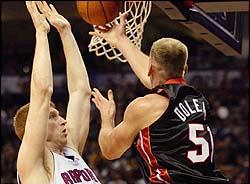
My friend is very proud of his seats, but also slightly embarrassed. They cost a lot of money, but he insists they are his only indulgence; there aren't many other things he wants or needs to buy (he drives a Toyota Prius to save money on gas).
In fact, he says he has turned down seats in the front row (apparently they cost $300 more each, per game, than those in Row 2). He couldn’t justify the cost. (Note: He could afford it. Just couldn't justify it.)
I think there are a few instructive notes to take from this experience, for anyone targetting entrepreneurs as a market:
* Entrepreneurs are price sensitive (okay, cheap). They know the cost of everything and the value of everything.
* They don’t hesitate to indulge themselves when they wish to. The sky’s almost the limit.
* Successful entrepreneurs are often embarrassed about their wealth and the things it can buy them. But beyond their homes and one or two indulgences, their needs really are few. To them, business is definitely about competing and winning, but once their basic needs (and highest indulgences) are met, the monetary rewards are secondary.
* If you're marketing to entrepreneurs, they probably don't have a budget (unlike corporate customers) for what you are selling. But if you can convince them they need your product or service, they’ll find the money.
* If they come presold, as my friend with his b-ball tickets, price is not a problem: the sky is almost the limit.
* Few entrepreneurs have to justify their buying decisions to any outsider. But they do have to justify it to themselves.
My friend also commented on the many other entrepreneurs he sees at Raptors games. It’s as if, competitive by nature, the best way for them to wind down is by coming to see other high-level professionals compete. Adrenalin: the best way to finish your day.
(As you might expect, my friend plays recreational basketball. And he hates to lose.)
Thursday, March 30, 2006
Small business folks "more motivated and excited" - and frustrated
Bill Sweetman, a Toronto-based Web marketer who recently became VP of Internet Strategy at MacLaren McCann Direct & Interactive, was interviewed last week on OneDegree.com, a terrific Canadian site for information on the e-economy.
As part of the discussion, he had some interesting insights on the difference between small business clients and big businesses:
One Degree: Who needs a bigger kick in the ass to get on the Net advertising bandwagon - big advertisers or small businesses?
Sweetman: Neither.
The small business folks, God bless them, are more motivated in and excited about advertising online, however they tend to have unrealistic expectations and not enough budget to do things effectively. In the worst cases, they think of Internet marketing as a cheap or free alternative to doing anything else, and then are frustrated when it doesn’t live up to their unrealistic expectations.
The big advertisers, on the other hand, have got plenty of budget and want to “do stuff online” but many are still skittish about re-directing an appropriate portion (based on reach) of their budget to a medium they don’t fully understand.
Small or large, I’m not blaming the advertisers because the responsibility rests with us Internet marketers (whether we are freelancers, at boutiques, or working at large agencies) to help our clients understand and then capitalize on the potential of this medium.”
This fits with a lot of evidence I’ve seen that small businesses are quicker and more eager to innovate than most bigger businesses – even if the entrepreneurs don't have as much available cash with which to explore new media and opportunities.
For the rest of the interview, go here.
Tuesday, March 28, 2006
Another bad ad
I’m a big believer in creative flexibility. If you have a great idea, throw out the old rules. But if you don't know what you’re doing, you might as well follow the rules, because your message is likely to get lost otherwise.
For instance, I believe in headlines. Whether you’re designing an ad or a newspaper page, you need headlines to attract easily distracted readers. If you have a big idea and/or an arresting visual (say, the World Trade Center collapsing), maybe you can get away without a headline. But if your main image is like the one at left, better get a good headline. You need all the help you can get.
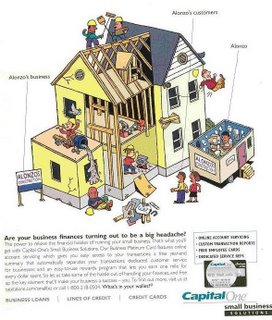
The ad at left appeared in the March issue of Fast Company. Capital One is targeting small business owners looking to tame their company finances. So where is the dramatic, benefit-oriented headline? It was deemed expendable, probably because the art director was so tickled with the cartoon.
Here’s the 411. Entrepreneurs want solutions. They don't want cartoons. They don't like cartoons. In my experience (and I once published a Dagwood/Mr. Dithers cartoon on the cover of PROFIT Magazine, but only once), business owners view cartons as kids’ stuff, not serious business. Plus, this is a complex cartoon with no central focus and no caption. Only readers with lots of time on their hands are going to sit down and try to figure out what it all means. When’s the last time you heard a busy entrepreneur say, “I’ve got nothing to do. Think I’ll spend an hour analyzing illustrations in this magazine.”
Worse, anyone who does study this cartoon finds the company being depicted is totally inept, its workers unprofessional at best, and likely suicidal. Few entrepreneurs find anything funny about unprofessional behavior. So if Capital One is expecting its prospects to identify with poor Alonzo, I think they're going to be disappointed.
Below the picture is the “sell” copy. It seems to have nothing to do with the cartoon. “Are your business finances turning out to be a big headache?” Alonzo’s problem is that his workers are building a substandard house and killing each other.
I could see this cartoon possibly working for an ad for a skills-training company, but it has no place in a serious financial ad.
The rest of the copy, about online account servicing, free year-end summaries and a rewards program, is good enough, I guess, but flat and uninteresting. It probably doesn't matter, since any entrepreneurs who stuck around to read the copy are going to find their heads hurting from trying to match the pitch with the cartoon, so they’re unlikely to last till the end.
The call to action? Buried at the tail end of a dense paragraph of low-contrast, hard-to-read body copy. No bold type for the URL, not even a “www” to help it stand out as a Web-based resource. Just a mess.
And don't get me started on the branded “Small Business Solutions” tagline. People with big dreams rarely like to be associated with such a demeaning word. (See my Jan. 10 post, Don’t call them “Small Business”.)
Takeaways: If you’re creating ads aimed at business owners, have a clear message. Help entrepreneurs solve their problems. Use headlines to attract attention. Keep your message simple. Don't monkey around with inappropriate humour (your audience takes itself very seriously). Use simple text devices (boldface, anyone?) to make your key messages stand out.
Note how Capital One put its own tagline [What’s in your wallet?] in bold instead of its key pitch, or its URL or phone number. Selling is about the customer’s needs, not yours.
For instance, I believe in headlines. Whether you’re designing an ad or a newspaper page, you need headlines to attract easily distracted readers. If you have a big idea and/or an arresting visual (say, the World Trade Center collapsing), maybe you can get away without a headline. But if your main image is like the one at left, better get a good headline. You need all the help you can get.
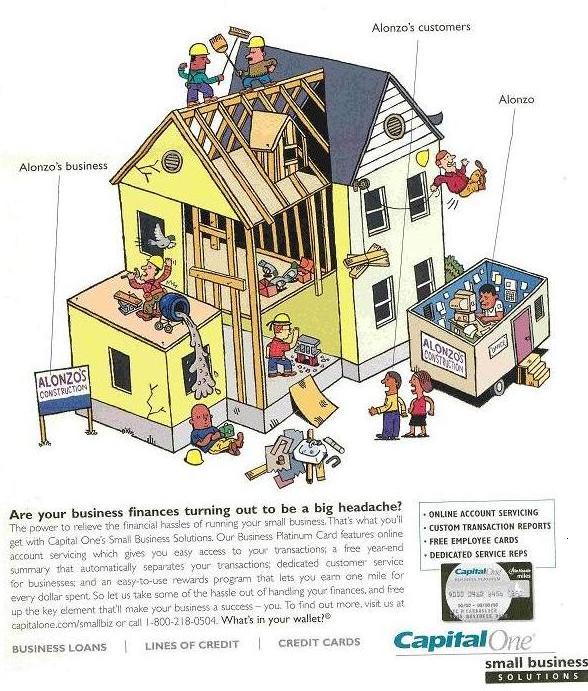
The ad at left appeared in the March issue of Fast Company. Capital One is targeting small business owners looking to tame their company finances. So where is the dramatic, benefit-oriented headline? It was deemed expendable, probably because the art director was so tickled with the cartoon.
Here’s the 411. Entrepreneurs want solutions. They don't want cartoons. They don't like cartoons. In my experience (and I once published a Dagwood/Mr. Dithers cartoon on the cover of PROFIT Magazine, but only once), business owners view cartons as kids’ stuff, not serious business. Plus, this is a complex cartoon with no central focus and no caption. Only readers with lots of time on their hands are going to sit down and try to figure out what it all means. When’s the last time you heard a busy entrepreneur say, “I’ve got nothing to do. Think I’ll spend an hour analyzing illustrations in this magazine.”
Worse, anyone who does study this cartoon finds the company being depicted is totally inept, its workers unprofessional at best, and likely suicidal. Few entrepreneurs find anything funny about unprofessional behavior. So if Capital One is expecting its prospects to identify with poor Alonzo, I think they're going to be disappointed.
Below the picture is the “sell” copy. It seems to have nothing to do with the cartoon. “Are your business finances turning out to be a big headache?” Alonzo’s problem is that his workers are building a substandard house and killing each other.
I could see this cartoon possibly working for an ad for a skills-training company, but it has no place in a serious financial ad.
The rest of the copy, about online account servicing, free year-end summaries and a rewards program, is good enough, I guess, but flat and uninteresting. It probably doesn't matter, since any entrepreneurs who stuck around to read the copy are going to find their heads hurting from trying to match the pitch with the cartoon, so they’re unlikely to last till the end.
The call to action? Buried at the tail end of a dense paragraph of low-contrast, hard-to-read body copy. No bold type for the URL, not even a “www” to help it stand out as a Web-based resource. Just a mess.
And don't get me started on the branded “Small Business Solutions” tagline. People with big dreams rarely like to be associated with such a demeaning word. (See my Jan. 10 post, Don’t call them “Small Business”.)
Takeaways: If you’re creating ads aimed at business owners, have a clear message. Help entrepreneurs solve their problems. Use headlines to attract attention. Keep your message simple. Don't monkey around with inappropriate humour (your audience takes itself very seriously). Use simple text devices (boldface, anyone?) to make your key messages stand out.
Note how Capital One put its own tagline [What’s in your wallet?] in bold instead of its key pitch, or its URL or phone number. Selling is about the customer’s needs, not yours.
Thursday, March 23, 2006
Today's Hottest Buttons
What problems most bedevil Canada’s entrepreneurs? Here are the results of a recent survey of “mid-cap” business owners by COMPAS, for Roynat Capital, conducted in January 2006.
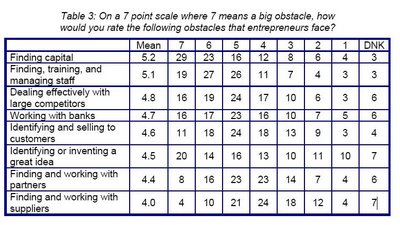
I’m actually surprised to see these entrepreneurs so concerned about financing. This is an issue that seemed to have gone away for a while; certainly, it is no longer the national political issue it was a few years ago.
This looks like a warning to the banks, especially for when they come back to Ottawa for permission to merge. Plus, it’s a sign that all the new private capital now being directed to buyout funds and mezzanine funding isn't getting where it needs to go.
Meanwhile, there’s lots of food for thought here for marketers trying to make entrepreneurs’ lives easier. How can you help them deal more effectively with staff issues (hiring, training, motivating, retaining)?
How can your products or services level the playing field, and enable entrepreneurial firms to compete with bigger organizations?
And how can you help them sell more?
These are the hot buttons your market will respond to.
(You can find the survey summary here. )
Thursday, March 09, 2006
No more pencils, no more books
School's out next week and the kids are demanding attention.
So Selling to Small Business is going into reruns till March 21.
How do reruns work? Simple. You scroll down and read the posts you haven't seen before.
As always, send your comments or suggestions to rick (a) rickspence.ca
And if you have time, check out our links to the left. Lots of good learning there.
Rick
Segmenting your market
What keeps entrepreneurs awake at night?
Before answering that question, you have to know which part of the small business market you're targeting. It's Marketing 101: this market is so huge and so variegated that anything you can do to segment your preferred audience (young entreprenurs, female business owners, manufacturers, startups in Manitoba, etc.) will result in finer targeting and produce better results.
Case in point: A January 2006 Industry Canada study of financing for young entrepreneurs.
Here are the "Perceived Obstacles to Business Growth and Development" identified by the study. As you will see, it found significant differences between young entrepreneurs and older ones.
Problems Facing Young Entrepreneurs
Finding Qualified Labour: 40%
Obtaining Financing: 39%
Instability of Demand: 25%
Levels of Taxation: 23%
Low Profitability: 19%
Government Regulations: 19%
Equipment Renewal: 13%
Managerial Skills: 11%
Problems Facing Older Business Owners
Levels of Taxation: 40%
Finding Qualified Labour: 38%
Low Profitability: 34%
Instability of Demand: 33%
Government Regulations: 29%
Obtaining Financing: 23%
Equipment Renewal: 17%
Managerial Skills: 6%
If you're targeting younger entrepreneurs, for instance, you wouldn't worry so much about taxation or high taxes. You might, however, focus on financing solutions. One thing is clear: both demographics are equally concerned about finding good help.
Why do young entrepreneurs matter? Well, apart fom the possibility of them being good customers for the next 30 yars or so, they are stepping up to the plate now and starting or buying businsses as more and more baby-boomer entrepreneurs look for a change or outright retirement. This is a market you need to know.
Sunday, March 05, 2006
How tech fails medium-sized business
Does the tech industry understand the medium-sized business market? Not according to Dan Mclean, editor-in-chief of ITWorldCanada.com, in a story published March 2 in The Globe & Mail.
“When it comes to information technology designed to suit their specific computing needs, mid-sized companies in Canada are on the outside looking in,” Mclean writes.
When businesses with between 100 and 499 employees look for tech solutions, what do they find? “These days they're typically scaled-down versions of large-business IT hardware, software and services, or scaled-up small-business products,” he writes.
The problem, says analyst John Sloan of Info-Tech in London, Ont., is that the IT needs of a mid-sized company can be every bit as complex as those of a much larger firm. But they have fewer people to support and manage it. That means mid-sized firms need products that have big-business function at a small-business price.
According to Sloan, two-thirds of a mid-sized business’s IT spending goes to maintenance and management. Anything that reduces the need for operational support “is likely to get a good hard look by a medium-sized business customer. Gains in efficiency and productivity are golden for customers in the mid-market.”
Medium-sized businesses are big IT spenders. On average, says Mclean, they spend more than $1 million a year on IT.
Lise Dellazizzo, VP of IT for Ipsos Reid Corp., calls medium business "the most significant revenue-generating engine in Canada when it comes to IT spending." Large businesses may spend more per capita, but the mid-sized market has greater volume. Canada has nearly seven times as many mid-sized companies as large companies.
As Mclean concludes, this is a market worth figuring out.
See the original story (until it slips behind the pay curtain) here.
Wednesday, March 01, 2006
The long drawn-out agony of giving up control
One of the big problems facing entrepreneurs is control.
When they found their business, entrepreneurs are in complete control. They have to be: they can't allow a free-thinking employee or supplier to undermine thier vision or the standards they are trying to create.
Some people dismiss entrepreneurs as “control freaks,” but they are this way for good reason. Just as a watchful she-bear will fight for her cubs, entrepreneur will take few chances that would endanger their business. When you take your eye off the business, danger is always close by.
(Recall 15 years ago when Magna founder Frank Stronach started dabbling in restaurants and politics -- his auto-parts company started to crumble. It was only when Frank returned to put his personal stamp on the business again that it recovered.)
Over time, then, entrepreneurs must battle hard to find systems that allow them to give up control without sacrificing quality, standards or culture.
In an article written a few years ago for PROFIT Magazine’s website, Markham, Ont. entrepreneur Aaron Moscoe, co-founder of a corporate-giftware firm called The Promotional Specialists, described his efforts to let go. Here are a few excerpts that speak to the difficulty of letting go – and the incredible opportunity that creates for suppliers and other potential partners who can win an entrepreneur’s trust.
"Having built this business personally, [my partner and I] like to have things done our way - and who better to do it exactly that way than ourselves? The problem is that there are too many accounts to manage to allow us the time to plan and manage our business properly. Like many small business entrepreneurs we have tried to just work harder. After a while you learn that there is not too much of this or that, but too few of you.
"Hiring others to do jobs that you handled previously is tough because it means relinquishing some control. (Rick’s note: the suggestion here is that relinquishing control is bad. I am sure Aaron has gotten over that notion now, and recognized that delegating is an essential skill – but it’s a hard concept for many to accept]. While you can train employees, you also need to trust them and to realize the various ways they can add value to your business, even if it is by doing things differently.
"Perhaps the most important way to grow is to realize that you must inevitably rely on others. Whether employees, suppliers, couriers, financiers, or key clients, it is dramatically important to choose those strategic partners carefully.”
You can read the rest of the story here, but here's the main point: When you sell services to entrepreneurs, they may be cautious, skeptical, even hostile, because they are being asked to entrust their business to your systems, your standards.
Once you recognize that pitching your product is much like asking new parents to entrust your baby to their care, you will better understand that your primary job is not to sell your services to entrepreneurs, but to win their trust. If you can do that, the rest gets much easier.
There are no quick wins in this market. As Moscoe concludes, “Partnerships must be mutually beneficial in the long run if they are to last. Accordingly, it is crucial to work with partners who value the contribution that your partnership brings to them.”
If you're listening, that's the sound of an entrepreneur demanding respect.
Monday, February 27, 2006
Countdown to Report on Small Business
The Globe and Mail plans to publish four issues of its new magazine, Report on Small Business, this year. (I think there were just two last year.)
I have concerns about the title (see previous post), but if you’re interested, there's still time to get in on the first issue. The ad deadline for the April 12 issue is March 7.
Here are the rest of the dates this year (cribbed from the Globe’s site here)
Issue date: June 22 Sales close: May 11
Issue date: Sept. 26 Sales close: Aug. 11
Issue date: Nov. 22 Sales close: Oct. 20
Curiously, the Globe’s website doesn't have much information on this new publication. (They also still refer to it as a “special report” rather than an ongoing magazine.) The editor is Noel Hulsman, a marathon runner who was formerly editor of BC Business.
Friday, February 24, 2006
Small is Beautiful. Powerful, too
Why should you care about Selling to Small Business? Because small and medium-sized businesses are an important growing force.
According to the government of Canada:
* Small businesses are much more adaptable and adopt new technologies and processes more quickly than large firms
* Businesses with fewer than 50 employees account for 95% of all companies in Canada.
* SMEs generated 43% of Canada’s private sector GDP in 1998.
* The number of self-employed Canadians has nearly doubled since 1980, to 2.4 million.
* In 2002, small businesses (under 100 employees) accounted for 20% of Canada’s total exports.
As they say, there is nothing small about small business.
Feel free to leave a comment or e-mail me if you want more information on any of these factoids.
Monday, February 20, 2006
A bad ad that redeems itself beautifully
 So, what are the results of “Results-Driven Advice?”
Looks to me like you’re left tottering uncertainly, facing almost certain ruin if you tip back even a bit.
But according to this ad from Grant Thornton in the latest issue of PROFIT Magazine, what this picture represents is “Perfect balance… achieved through working hard, having fun and always giving great client service.”
Maybe. But to me balance is a chair with four feet on the ground, not two.
The other problem with this ad is the incredibly tenuous link to the client benefit. The image and the “balance” theme have nothing to do with Grant Thornton.
The payoff line is this: “The financial advisory service that fits us? Grant Thornton. Their insights and guidance help us sit pretty and considering we’re in the office furniture business, that's a very good thing.”
The key, then, is the incredibly lame pun about “sitting pretty.”
One more problem: While it’s a so
 und idea to use real entrepreneurs and their testimonials in ads (because entrepreneurs only really trust each other), you need to follow through. For instance, while Jim Mills (pictured above) and his company, Office Interiors, seem to be real (and Halifax-based, no less), the URL they provide, www.officeinteriors.ca/, isn’t working. Here is the screen that URL served up on Sunday night.
(Monday night update: The company's website was back in business when I checked again tonight.)
So what redeems this ad? Grant Thornton’s respect for its entrepreneurial prospect – and his or her ego. The action step in the lower text box is to call or e-mail GT’s CEO, Alex MacBeath, through a toll-free number or what appears to be his actual e-mail address.
This is classy. We’re not sending you to a website or an $8-an-hour call centre clerk. Speak to the boss, CEO to CEO. Because you’re worth it.
I bet that’ll do more to make the phone ring than the smug guy in the unsafe stool.
YOUR TAKEAWAY: Treat entrepreneurial clients as important individuals. Because in their world, they're the boss. And they expect to be treated as such.
Tuesday, February 14, 2006
Weaknesses? Maybe a few.
Entrepreneurs often have healthy egos, but they can still admit to shortcomings.
Here, courtesy of PROFITguide.com, is a listing of self-diagnosed strengths and weaknesses compiled from entrepreneurs on the 2001 PROFIT100 list of Canada's Fastest-Growing Companies.
I thought it might help you better understand the complex, often contradictory personalities of successful entrepreneurs. You may even detect a few patterns. Enjoy!
1. What do you consider your key personal strength in business?
Thanks to many years of working with some great companies and great bosses, I would suggest that my greatest strength is vision. Put a stake in the ground and shoot for it.
What's your biggest weakness? Lack of attention to detail.
2. STRENGTH: My attention to detail. Plus, I'm paranoid.
WEAKNESS: I'm not sure. That's probably my weakness.
3. STRENGTH: I'm good at vision — what needs to be done — and action-oriented to do it.
WEAKNESS: Impatience.
4. STRENGTH: I hope my key strength is the ability to create and maintain a teamwork environment.
WEAKNESS: Probably the biggest weakness, and something I'm working on very hard, is the ability to delegate more.
5.STRENGTH: The ability to hire good people.
WEAKNESS: I'm probably a bit soft, a bit lax. I don't think I'm a tough enough manager.
6. STRENGTH: Feisty, creative, aware. I'm an opportunist.
WEAKNESS: Inability to say no. No to anything.
7. STRENGTH: Entrepreneurial nature — I find a way to make things work.
WEAKNESS: I don't pay enough attention to fine detail, I'm more attracted to the possibilities than the details of implementation. Luckily, I know that and we hire accordingly.
8. STRENGTH: The ability to keep multiple balls up in the air. The very thing that you were critiqued for in school, which was the fact that you were thinking about 12 things at once, is the very thing that keeps you sharp in business.
WEAKNESS: I'd genuinely like to have better listening skills.
9. STRENGTH: I don't have any. I guess it's it would be delegating. Not thinking I can do it all. Knowing my limitations.
WEAKNESS: My biggest weakness would be probably lack of general business experience.
10. STRENGTH: I have a pretty sound technical knowledge of the field that we're in.
WEAKNESS: I'm not formally educated in business. I had to pick it up on the fly.
11. STRENGTH: Vision.
WEAKNESS: Staying focussed.
12. STRENGTH: I'm left and right brain — I'm good creatively and technically.
WEAKNESS: I'm always looking for compromise. Sometimes I should hit the table with my fist.
Saturday, February 11, 2006
What Entrepreneurs Want, part 3
Some of my posts mentioning the solitude and problems of entrepreneurs - especially the lack of peer contact - might make you conclude that these are needy and vulnerable people. Nothing could be farther from the truth. Entrepreneurs crave respect and understanding like everyone else, but they can go without both for long periods of time, driven by their vision and their instincts for the best way of serving their niche.
But once in a while, they like to be stroked and to have their work confirmed by others.
This was reaffirmed for me again yesterday in two e-mails I received in response to a speech I gave Wednesday night on Lessons from Canada's Emerging Growth Companies (click here for a summary). My presentation to a group called Future Leaders involved analyzing some of the trends in entrepreneurial growth (as divined from PROFIT Magazine's PROFIT 100 research) and documenting some of the unique tactics and strategies that have fuelled their success.
My goal with such presentations is to show entrepreneurs how other companies are striving and succeeding, and give them specific tactics they can put into practice right away. But sometimes I forget how important it is just to be heard talking about success in tough times.
Here's a snippet from one of the unsolicited e-mails I received the other day:
"Just wanted to drop you a quick note to let you know that I really enjoyed your presentation... It was extremely interesting and inspirational."
You might think that entrepreneurs would be the last people to need inspiration. But you'd be wrong.
The other e-mail:
"Thanks for the speech on Wednesday. Some days any encouragement is appreciated. As a manufacturing guy, I really appreciated that I’m not the only one in this province who still thinks making stuff is a good business and finding that you can still manufacture and make the hot [PROFIT 100] list is nice ... despite the money guys telling everyone out there that manufacturing in Ontario is dead and the dumbest possible thing you can do."
I don't believe entrepreneurs are generally insecure. But if they're to put all their energy and resources into a business venture, they certainly need a strong dose of confidence. And confidence is a fragile thing.
Marketer's Takeaway: You can't go wrong by celebrating the instincts and accomplishments of entrepreneurs. It doesn't have to be the major theme of your conversation with this market, but it must underlie everything you say and do.
As the writer said, "Some days any encouragement is appreciated."
Wednesday, February 08, 2006
RBC's four-star ad
Regular readers will be pleased to learn that I’ve found an ad targeting small business that I actually like.
The fact that it appears opposite my new column in the Feb.-March issue of MoneySense is just a coincidence.
It’s an ad for RBC Royal Bank, part of its mysterious series of ads whose photos include people standing in front of a shoulder-high billboard with the word “FIRST”. (I always thought “First” was part of Bank of Montreal’s branding, so I am still confused by its use by the Royal.)
The ad starts with a great headline: “After his business burned down, Steve Booy not only found out who his friends were. He discovered who his bank was.”
The body copy goes on to explain that when Steve’s Automotive Repair in Woodstock, Ont., went up in flames, all his financial records were lost. Kindly waiving an immediate loan payment, an RBC account manager sat down with Steve to discuss the future. (“Without financial records,” RBC says, “some banks might not have talked to Steve.”) But RBC “was flexible, finding a financial solution that recognized his specific circumstances.”
The result? “Today, an expanded Steve’s Automotive is a state-of-the-art nine-bay facility,” “well-equipped, Steve says, with fire extinguishers.”
There you have it. An ad that tells a believable, human story. Like all great stories, form the first ancient myths to Star Wars, it comes complete with a problem, a hero (that creative banker) and a happy ending.
Plus, the tale is told simply and efficiently, to match entrepreneurs’ attention spans – using just enough details to make it credible, and even a grin-worthy punch line.
And at the end, of course, comes the call to action that every ad should have (but many don’t): “To find out what RBC Royal Bank can do to put your business first, call 1-800 ROYAL 2-0, or visit www.rbcroyalbank.com/business-first”
Note the subtle reinforcement of the “first” branding, and the ease of the contact tools offered: a toll-free number that’s easy to remember, and a URL that’s easy to type.
The ad itself speaks to the loneliness and vulnerability that applies to most entrepreneurs (and which I have discussed in numerous posts, including the one immediately preceding this one). RBC depicts an entrepreneur at his lowest point, and describes how it stood by him. That kind of security, that kind of relationship, is exactly what most entrepreneurs want.
This ad works because it speaks entrepreneurs’ language, it understands their needs without overstating them, it’s grounded in reality, and it offers a clear and genuine benefit. I give it four stars.
PLUS: In promoting this apparently true story (you can visit http://www.stevesauto.ca), RBC’s ad does one more thing – it raises expectations.
It ups the ante. It dares other bankers – within the Royal or its many competitors – to do for their clients what Steve’s account manager did for him. This could come back to haunt RBC – can its bankers work such magic all the time? (Especially given that many credit-watchers say the banks are set to tighten up on credit as the Canadian economy peaks.)
In the meantime, setting the bar so high makes a great testimonial for RBC – and a nice shot of confidence (and bargaining power) for entrepreneurs across the country.
Full disclosure: I do most of my personal banking at the Royal, mainly because my dad worked there all his life. But if you think that kind of thing influences my writing, you haven’t been reading my stuff very long.
Monday, February 06, 2006
Be a peer, not a pal
Friends are fine. Families have their place. But there's nothing like people you hardly know.
At least, that’s how my friend Aaron sees it. A seasoned entrepreneur, he is an enthusiastic participant in Entrepreneurs’ Organization, the international forum that allows full-time entrepreneurs to meet monthly with local peers from non-competing organizations to share ideas, contacts and best practices. (And, mainly, to reassure each other that the hell they go through every day is normal.)
“Most entrepreneurs don't know other entrepreneurs, unless they're customers or suppliers, or family or friends,” says Aaron. These are useful, even valuable contacts, but they're not the best people to pour out your heart if you want to talk about the pressure the bank’s putting on you, the new problems with your sales force, or your spouse’s growing resentment of your long hours at work.
That’s why entrepreneurs join groups such as Presidents’ Organization, Entrepreneurs’ Organization, CAFÉ, Innovators Alliance, and so on – to share the burden. Unloading with trusted colleagues who understand what you're going through relieves some of the loneliness and the burden. And chances are good that some of them will have gone through what you're experiencing, and will be able to offer useful advice.
Remember, corporate executives have a ready-made audience of peers, mentors and friends – usually all in the same company - for blowing off steam and seeking counsel. Entrepreneurs are in a different space entirely. Which is why they appreciate marketers who understand their real needs.
Bonus thoughts - Let's consider the implications of the lonely-at-the-top, no-one-to-confide-in life of an entrepreneur:
Nobody to bounce ideas off of: So keep your offers simple. Offer lots of easy-to-read info and context on your website for those who need to dig deep.
Overloaded, working too much: Respect their time. Keep policies and paperwork to a minimum.
Fear of making mistakes: Take away some of the risk. (Offer free trials, extended warranties, money-back guarantees).
Need for solutions: Be a peer, not a pal.
Thursday, February 02, 2006
Mars and Venus and Small Business
A few posts back (on January 10, if you want to look it up in the “January” archives on the right) I blogged about the phrase “small business.” I suggested that while it is a useful description of a category, you should not use it when addressing people who run small businesses – because one of the meanings of “small” is inconsequential. I even went back to my experience 15 years ago at PROFIT magazine, which we renamed from the previous title, Small Business, for that reason.
As you may know, another magazine recently went through a similar name change. In 2004, Small Business Canada renamed itself Enterprise – probably for the same reason we changed Small Business. Because many readers don’t identify with the term, and few advertisers like to pay to reach markets that are apparently inconsequential.
Anyway, a friend of mine who is familiar with that magazine was saying yesterday that she thought the name change was a good idea: “Because men will never buy anything with the word ‘small’ in it.”

I hadn’t realized this phenomenon was gender-based, but maybe it is. “Call it, ‘Huge Business,’” advised my friend. “Or ‘Fast-Growing Business’. Men will buy anything that’s big.”
It’s a different perspective from mine, but the result is pretty much the same. Keep “small business” for internal use. “Business owners” sounds much more flattering.
Even consequential.
As you may know, another magazine recently went through a similar name change. In 2004, Small Business Canada renamed itself Enterprise – probably for the same reason we changed Small Business. Because many readers don’t identify with the term, and few advertisers like to pay to reach markets that are apparently inconsequential.
Anyway, a friend of mine who is familiar with that magazine was saying yesterday that she thought the name change was a good idea: “Because men will never buy anything with the word ‘small’ in it.”

I hadn’t realized this phenomenon was gender-based, but maybe it is. “Call it, ‘Huge Business,’” advised my friend. “Or ‘Fast-Growing Business’. Men will buy anything that’s big.”
It’s a different perspective from mine, but the result is pretty much the same. Keep “small business” for internal use. “Business owners” sounds much more flattering.
Even consequential.
Subscribe to:
Posts (Atom)
