Monday, July 31, 2006

How to reach the CEO

I was talking recently with a prospective client who was keen to target CEOs. And while I tend to think of myself as the “entrepreneur” guy, in truth, I have been writing for CEOs for 25 years.

Not only the CEOs of entrepreneurial companies, but of big businesses as well. My education in journalism came at the Financial Times of Canada, the weekly business tabloid that aimed at top corporate decision-makers.

In six years I went from temporary summer replacement to managing editor (the guy who runs the newsroom). The reason? With a lot of patient coaching from terrific editors such as David Tafler, Paul Nowack, Terry Corcoran and Ron Blunn, I figured out what it takes to engage the CEO.

Here’s what I had pounded into my head every week about catching the attention of CEOs:

* Offer them an advantage. Call it a benefit if you must, but these are competitive people. They prefer solutions that do more than just help them – they want products, services and information that put them ahead of the other guys.

* Keep it relevant. You have to be as focused as they are. As soon as you appear to wander or go off track, CEOs will turn the page, change the channel, or start looking at their watch.

* Be timely. When they need you, they need you now. If you get to them a day late, you've lost the sale.

* Be specific. Don’t just say your solution can boost the bottom line. Explain quickly and exactly what your product or service does and how it will help them.

* Use clear and simple examples. Don’t expect them to connect the dots for you or reach the conclusion you want. Spell it out.

* Use humour sparingly. If they don't find it funny, they’ll think you're wasting their time. And there’s no worse sin than that.

(Click here for my tribute to Ron Blunn, one of my editors at the Times, who passed away in June at the age of 56.)

Tuesday, June 27, 2006

Direct Mail that almost worked

Direct mail is a lost art. As consumers, we’ve come to recognize time-wasting ad material even when it comes in a sealed envelope, and we automatically file it where it can do the least harm.

But then there’s this DM package that arrived in my mailbox a few weeks ago from Bell Canada. It begged to be opened. When you looked at the transparent back of the envelope, you could see this 5x7" "Open for Business" sign, just like you might find at a quality stationery store.

You tear the envelope open and it’s exactly what you thought – a very cool “Open for Business” sign on heavy, glossy stock. High quality and tough enough to put on your office door or in the front window of your store.

The back of the card offers this pitch: “Visit www.bell.ca/open to log in with your enclosed Preferred Business I.D. now!”

That’s not exactly a strong benefit statement. But the “Open” card is so cool that you're ready to give Bell the benefit of the doubt. So you actually look at the color brochure that came with the sign. Although the headline is vague (“We’re Open for Your Business 24/7!”), the thematic link to the sign is so strong that I went ahead and opened the four-page brochure.

Alas, this is where it all breaks down. You get a two-page spread about – well, something. It has product demos that have something to do with a BlackBerry, it offers opinion polls from Canadian business people, a Solution Generator (“for a customized wireless recommendation”), and BizNews articles that offer “the expert opinion and newsworthy information you want to know.”

So, I guess it’s some sort of website. Does it have a name? A brand? Apparently not.

The marketing bumph calls it, variously, www.bell.ca/open (which strikes me as an address, not a name); “one valuable resource for everything you need” regarding wireless solutions; “one convenient and easily accessible place”; “access to instant information for all aspects of your business”; and, “the site.”

The d-m guys got the concept right. They created a must-open package that arrests the attention of business owners. But boy did the product copywriters let them down.

Still, everyone who got the package also received their very own “Preferred Business I.D.” password that provides “open access” to the site. There’s nothing entrepreneurs like better than feeling like a VIP, so maybe some of them went to the site just to see what preferred benefits were on offer.

But if they did, they were proceeding on curiosity, not in search of a product or benefit. Which means that while Bell might get them to go where it wanted, these visitors are ready to bail at the first sign of a hard sell – or any evidence that they're not as special as they’ve been led to believe.

Will Bell be up to the challenge? Is Donald Trump’s hair colour real? Check out our next post for the gruesome details.

Wednesday, June 21, 2006

Marketers' biggest mistake

What's the worst mistake big-business people make when marketing to small business?

Warrillow & Co., a Toronto-based company that researches the small business market on behalf of bigger clients, asked that question of Gary Slack, chairman & "Chief Experience Officer" of Chicago-based Slack Barshinger, an integrated marketing agency focussed on business-to-business. Slack Barshinger was BtoB magazine’s 2006 Midsize Agency of the Year, and the Business Marketing Association’s 2006 Agency of the Year.

Warrillow: "What’s the biggest mistake you see enterprise companies make when they target small businesses?"

Slack: "I think the biggest mistake we see enterprise firms make is assuming they understand the needs, challenges and mindset of their small-business customers and prospects. We still too commonly encounter marketers who try to arrive at the answers to critical questions by arguing them out around conference tables rather than doing the research required to really understand the marketplace.

"On top of that, we also see enterprise companies sometimes make the mistake of assuming that small companies are the same as their own company – for example, large, bureaucratic, territorial and slow to act. They don’t sufficiently appreciate how quickly decisions can be made at a smaller company, assuming you have reached the right person or persons with the right message.

"Last but not least, we’ve also found that enterprise firms sometimes make blanket assumptions about the SMB buying process related to their product or service... assumptions that may prove incorrect. In the chaotic world of SMB life, job descriptions cover a fraction of what an individual actually does, and research is needed to truly understand all the potential players who might be involved in a purchasing decision, what information those individuals will seek, their various pain points, and what steps they will follow in their firm’s buying cycle."

In my opinion, the trouble with researching small business habits is that they're so different. A focus group of 10 people couldn't begin to cover the broad spectrum of possible small business attitudes and behaviours. Yet quantitative research is so limited in terms of covering multiple options and open-ended behaviours and attitudes.

So what's a marketer to do? Cover off multiple options: one-on-one research and experience, small-group interviews, and quantitative surveys. The hard part, though, it to synthesize the information and convey the resulting intelligence and insights to everyone in your marketing, product development and executive teams who needs to understand these markets.

Fortunately, technology has come up with unique new solutions for that. Internal blogs and wikis are great ways of recording, sharing and understanding an ongoing wave of information. And you can control access to any participants you wish.

I know, I know. Something new to research. But don't worry. Blogs and wikis are easy to learn, simple to use and easy to set up, yet cost next to nothing.

And they're a great way to ensure that your hard-earned research gets understood and gets used.

For more of Warrillow's interview with Slack, click here.

Wednesday, June 07, 2006

Keep it short, Stupid!

There's a saying in marketing that long copy is better-read than short copy - if its value message is sufficently compelling.

Does this rule apply to small busines owners? Probably not.

Consider the entrepreneur I met with today. We were talking about getting phone and e-mail messages through to business prospects, and his view was this: "I never write or read long e-mails."

I was shocked. He really ignores e-mails of more than a couple of pragraphs? Yep, he said, although he admitted that missives from family and friends might get through his screen - but not business contacts.

And isn't he worried about missing something important? Hasn't this practice come back to bite him? His response to both questions: "No."

But then, he said, most of his e-mail comes from other entrepreneurs and people who are used to working with them. So they follow pretty much the same philosophy as he does.

In small business, brevity is the soul of profit. How quickly does your messgae get across?

Tuesday, May 30, 2006

Can small business use your site?

Internet “usabilty” expert Jakob Nielsen is puzzled.

In an e-mail newsletter article today, he writes about business to business websites – and why they're so hard to use.

“User testing shows that business-to-business websites have substantially lower usability than mainstream consumer sites,” says Nielsen. “If they want to convert more prospects into leads, B2B sites should follow more guidelines and make it easier for prospects to research their offerings.”

Nielsen says many B2B sites are “stuck in the 1990s” in their attitude to the user experience. They emphasize internally focused design and fail to answer customers' main questions.

“These sites haven't realized that the Web has reversed the company-customer relationship,” says Nielsen. “Most online interactions are demand-driven: you either give people what they want or watch as they abandon your site for the competition's.”

In Nielsen’s user tests, B2B sites earned a mere 58% success rate (measured as the percentage of that time users accomplished their tasks on a site). Mainstream websites had a success rate of 66%.

Here’s the puzzle. “Considering that there's immensely more money at stake for B2B than for business-to-consumer," says Nielsen, "it's astounding that B2B sites offer a much worse user experience.”

For pete's sake, put the customer first.

For Nielsen's full details, click here.

Interested in usability issues? Canada now has its own usability blogger: Dmitry Buterin of Bonasource. He's actually pretty good (so you'd better hope he doesn't find your site). Click here for his blog, Blinking VCR.

Friday, May 26, 2006

Move your prospects forward, faster

I have a professional services client in Toronto that is very interested in the entrepreneurial market, so I have been working with them to help them understand better how to identify and work with growth entrepreneurs.

Yesterday we held a session with one of Canada’s top growth leaders as he candidly outlined some of the problems he has faced in his business.

One of his comments should be of immense interest to anyone selling services and systems to small business.

Every entrepreneur in a growing business faces a conflict between trying to develop the staff that has been with the company for a long time, and bringing in more experienced professionals who really know how to do the job. Essentially, the conflict is the business’s need for greater professionalism vs the entrepreneur’s sense of loyalty to the people who have helped the company grow – but may no longer be the best people to help it grow further.

This entrepreneur admitted he was very slow to resolve that conflict. In the end, there was no doubt – without more professional management, his company was doomed. He took the plunge and brought in new people with the skills he needed. Some of his long-serving colleagues accepted reassignment; others accepted severance.

Most services companies targeting small business are selling professionalism. But not all entrepreneurs are ready to buy. Like yesterday’s guest speaker, many put it off for years. This suggests that there is a huge opportunity to sell more professional services to more entrepreneurial companies earlier – if you can help the leaders deal with their natural reluctance to upset the delicate balance of people and skills they have set up in their businesses.

How can you get loyalty-minded entrepreneurs to move forward faster?

Acknowledging their dilemma is one step. Explaining how other entrepreneurial clients have successfully solved this problem would be another. Paint a picture of what success looks like – and why so many more people – staff, customers, other stakeholders – will be better off in the long run.

Review your experience and ransack your client list to identify success stories of how you have helped other entrepreneurial firms grow stronger and faster by establishing more effective processes. Ask satisfied past clients if you can refer prospects to them for a personal discussion on how to manage such tricky transitions.

Entrepreneurs distrust experts who promise them the moon. Like everyone else, they tend to drag their feet when change is painful. But they are willing to listen – and act – if you have compelling evidence and testimonials proving that short-term pain will produce sustained long-term gain.

The client company will be stronger for it. And so will yours.

Thursday, May 18, 2006

Entrepreneur Reality Check

While looking for something else (as always), I ran across a great post on how an entrepreneur’s strengths become weaknesses – written by entrepreneur Thomas J. Leonard for all the long-suffering spouses of entrepreneurs.

It’s a great way to study both the common characteristics of entrepreneurs, as well as their needs (and thus your opportunities to help them).

The post, “The Top 10 Great Qualities of the Entrepreneur that Cause the Most Problems,” dates back to 1996, but it is none the worse for that. The species hasn’t evolved much since then.

Here’s my summary.
1. Can't focus, lots of ideas, runs in circles.
The entrepreneur's currency is ideas, often a flood of ideas. Encourage MORE ideas, don't try to pin them down.
2. Not good with details.
Suggest they give up even trying. Sure, this may create a mess, but challenge the entrepreneur to solve the mess as if the mess was a new business! (Entrepreneurs are like kids; it's good to divert them.)
3. Feel odd, different, alone, strange.
Entrepreneurs are simply wired differently and they SHOULD feel this way, because it's TRUE and there is nothing wrong with it. If you can help the entrepreneur relish their unique, contrary, leading edge ways, you'll help them feel better about themselves, which will increase the flow of ideas and success.
4. Good at starting businesses, bad at running them.
Help the entrepreneur to set a "sell date" right now, so they know they're getting out and when! This relieves some of the pressure and also forces the entrepreneur to create a salable company vs. one that is just a monument to their ego.
5. Chaos reigns in the company.
Creation is messy! A solution is to help the entrepreneur create fully automated and foolproof systems, usually managed by outside contractors or vendors who are not IN the business day to day.
6. They fail. And fail again.
Just as a kid has to fall when learning to ride a bike, so do entrepreneurs fail as they learn how to be successful.
7. They exaggerate and are too optimistic.
Entrepreneurs are so far out in front of the rest of us that they NEED to exaggerate how well things are going, in order to keep the faith -- hey it's lonely out in front (or in left field).
8. Always at the edge financially.
Get the entrepreneur to direct this energy into creating a healthy savings account instead of leveraging so much.
9. Family of the entrepreneur suffers.
You didn't just marry a man or woman, you married an ENTREPRENEUR! Develop your own strong interests and let your husband/wife do their own thing. You'll always be #2 (well, maybe #1 and a half). You can have a great marriage if you get this.
10. Sales dip.
Take this as an invitation for the entrepreneur to get back to selling, where they usually shine.

I agree with most of these, though No. 9 seems excessively harsh. What do you think?

For the original post, see http://topten.org/public/AA/AA3.html

Monday, May 15, 2006

The entrepreneur's favourite knowledge tool

Enterprise Toronto, the municipal agency dedicated to new business development, recently polled its visitors (most of them are presumably business owners or aspiring so) about their principal sources of small business knowledge.

I was pretty surprised at the one-sided nature of the result. I guess I shouldn't have been, but in blogs one is supposed to be truthful.

The major source of small business knowledge cited by 41.5% of the 106 respondents was…


(a few blank lines to build the tension and give you time to guess)


(a few more blank lines to further build the tension and give you time to change your guess)


The major source of small business knowledge cited by 41.5% of respondents was… the Internet!

I have known for a long time that entrepreneurs are wary of books and magazines and formal instruction, and that they prefer the school-of-hard-knocks wisdom they can derive from discussions with experienced business people. But I was surprised to see the Internet run away with it all.

The actual results:
What is your major source for small business knowledge?

The Internet – 44 (41.5%)
On the Job Experience – 24 (22.6%)
Books - 13 (12.26%)
Seminars – 13 (12.26%)
Other Entrepreneurs – 6 (5.7%)
School – 5 (4.7%)
Audio/Video Programs – 1 (0.94%)

Obviously these aren’t the only sources entrepreneurs use – but merely the distribution of their preferred methods. With just over 100 respondents, this is clearly not a scientific sample. But I think the results are important.

(Although I wish they hadn't included "On the Job Experience" as an option. That's a different kind of knowledge, and it's one which everyone has and gains more of daily, so I think it diminished the results for some of the other sources of info.)

So why did the Net win so big? With the flexibility of Google and other search tools, the Net’s round-the-clock availability, and the sheer depth of (mostly free!) business, management, market and financial information online, the Internet is a tool almost made to order for entrepreneurs. The question is: what are they looking up, and why? **

Follow-Up: How are your customers using the Internet? And how can you use digital technologies to reach them when they are using their favourite mode of business research?

(**Of course, there is also the matter of sample bias. You would expect the results of an online survey to reflect the fact that all respondents, by definition, already use the Net for business purposes. I think the same bias accounts for the relatively high ranking of the fourth result, Seminars, since ET puts on lots of workshops and seminars, for beginners and experienced entrepreneurs alike.)

Thursday, May 11, 2006

Luck, or something like it

I was talking to a Canadian entrepreneur recently who has a fabulous view on luck.

In the past 10 years he has seen one business partnership crumble, then another partner die. His office has been flooded out, at great expense. And as most of his revenues come from U.S. customers, the rise of the Canadian dollar has been nearly lethal.

Yet he still considers himself a lucky man.

Typical entrepreneurial megalomania? Hardly. He’s just figured out where success comes from.

Here’s how he sees it. In baseball, you get three strikes and you're out. But in business you can keep swinging as long as you want – so long as you’re standing at home plate. Take enough pitches and eventually you’ll get one you can hit out of the park.

So despite tragedy, floods and cash-flow crunches (and a nightmare insurance claim), this entrepreneur considers himself lucky because nothing has ever knocked him off home plate for long. That’s why his motto is: “The secret of success in business is staying in business.”

And by the way – he and his company have been hitting a bunch of home runs lately. No one deserves it more.

Friday, May 05, 2006

How to sell to Entrepreneurs, part deux

Last month I offered five characteristics of growth entrepreneurs, and speculated on what they may mean to marketers. If you haven't read that post, scroll down two posts or click here before reading on.

Growth companies are a huge potential market, fiercely loyal and ready to buy. To help you tap this growing market, here are five more attributes of successful entrepreneurs and growth firms - with a few clues about how you can use that information to sell to them.

6) An abiding personal interest in their products or industry helps most growth entrepreneurs persevere and succeed. Tip: Sell with passion. Entrepreneurs expect you to be as excited about your product as they are about theirs.

7) Growth firms pour most of their profits back into the business. However successful these businesses are, many remain cash-poor for years. Tip: When they question your price they're not being "cheap" - they have legitimate cash-flow concerns. To make the sale, acknowledge those concerns and address this need.

8) Growth firms think and operate globally. For them, borders are opportunities, not obstacles. Result: They need solutions that will work around the world.

9) These firms are keen to keep growing. That means their needs are always changing. And it means your products and services must be able to serve these customers all along their growth path.

10) These companies are on missions. Many of today’s top growth entrepreneurs truly believe their products and services can make the world a better place. Tip: To connect with these entrepreneurs, your business brand should stand for something, too.

If you want to add to this list, or if you have questions about any of these characteristics, please leave a comment below. Or e-mail me at rick(at)rickspence.ca

Tuesday, May 02, 2006

What do women entrepreneurs want?

According to a recent survey by RBC Financial Group, personal priorities are more important than money in motivating women to start their own businesses.

Just 23% of women polled said getting wealthy was a prime motivator for owning their own business. The comparable figure for men was 36%.

By contrast, 63% of women said they wanted a more flexible working schedule. (Editor's note: What were they thinking?)

According to Kris Depencier, RBC's national manager for small business, "for a large portion of these women, building a business is not only a labour of love, but also a way to balance work and family obligations."

The survey found other differences between men and women entrepreneurs:

* Currently, more women (73%) were first-time business owners than men (65%);
* Women are more likely to employ a spouse or child in the business (59% of women vs 47% of men).

Men and women described surprisingly similar frustrations when asked about their key problems in launching and running a business. Their three main challenges:

* finding customers (57% women/56% men);
* keeping a steady workload (37% women/38% men);
* and working long hours (34% each). (Editor's note: See previous editor's note.)

In my experience, people who get into their own business to gain more control over their time are like a kid who joins the army to get some peace and quiet.

Marketer's takeaway: How can you help entrepreneurs find more time in their schedules? How can you help them make the most of the spare hours they find to themselves?

Or better still: how can you help them land more customers?
Chant that like a mantra and you will always have the entrepreneur's ear.

Friday, April 21, 2006

How to sell to Entrepreneurs

My study of the 2005 list of Canada’s Fastest-Growing Companies, published by PROFIT Magazine, helped me identify 10 common characteristics of fast-growth companies. These commonalities also suggest appropriate tactics for marketing to these firms.

1) These companies are founded on innovation. They present new solutions to their markets, not business as usual. If you are offering products and solutions that are new and improved, they’d better be genuine improvements, because these firms have invested in innovation - and expect you to do so as well.

2) These firms offer real value in the marketplace: new solutions, better service, lower prices. How else does a new business break into today’s crowded markets? Since these emerging companies create so much value for their clients, they expect value from their suppliers in return. They are most receptive to marketers who also put value and customer benefit first.

3) Most of these companies succeed through productive partnerships with other organizations. These companies understand win-win, and they expect you to, too.

4) Their founders have leveraged personal relationships to get where they are today. They are innovative dealmakers. And they expect no less from you.

5) Being an emerging business doesn’t mean you lack experience; many of these entrepreneurs brought years of industry experience to the table. Expect entrepreneurial clients to combine small-biz focus and agility with big-business discipline and toughness.

The next 5 points? Just click here.

Tuesday, April 18, 2006

The spouse at the centre of the storm

If you think entrepreneurs are a tough breed to figure out, imagine being married to one.

The life of an entrepreneurial wife (or husband) can be filled with tension, uncertainty, hard work and loneliness. That’s all forgotten when the business succeeds and they start buying the brand-name scotch, but it’s a tiring, roller-coaster ride while it lasts.

Remind me to tell you about the roundtable I held at PROFIT Magazine a few years ago, when we gathered some wives of local young entrepreneurs to spill the beans on what life at the centre of the whirlwind is really like. It’s not as easy as it looks.

In the meantime, Laura Bailey of Crain's Detroit Business magazine wrote a story in November 2003 on the hectic lives of entrepreneurs’ spouses. The story itself is beyond the pay wall here, but it makes some great points:

* Robert Dube, owner of Oak Park-based Image One Corp., and his wife, Emily, are so busy they have to schedule a special weekly lunch to discuss family issues.

* "It's almost like there's a third party in your marriage,'' said Melanie Zauel, whose husband, Brian, co-owns Wixom-based Cornerstone Engineering, a full-service architectural firm that today has 19 employees. "Sometimes all of his energy is used up in work, and there isn't anything left for the rest of the family.''

(Not that she’s complaining. "I wouldn't want to be married to somebody who is miserable because he is working for somebody else,'' she added. )

* Work-life balance is one of the biggest concerns for entrepreneurs, and often it's up to the spouse to keep that harmony.

* Another issue that entrepreneurs grapple with is finances. Money provides ammunition for fights in any marriage, but for entrepreneurs it's worse.

"There's not a person in the (Young Entrepreneurs Organization) that does not have their house and personal assets on the line,'' said Tom Nardone, president of Isdera Corp… YEO is a support group and networking organization for entrepreneurs under age 40 with $1 million or more in annual revenue, and Nardone said work-family balance is the group's biggest issue.

* And don't think the husbands of business owners get off easy. “I maybe do some things (around the house) that some of my friends don't do,'' such as more laundry or evenly dividing the household chores, said David Cattermole, senior design engineer for Troy-based Compunetics Inc. He is married to Laura Cattermole, founder of Farmington-based IT staffing company RemTech Business Solutions. For example, he cooks and she washes or vice versa.
"We're a team,'' says David.

Wednesday, April 12, 2006

The Entrepreneur’s Family

I just drove back from Kingston, where I MC’d the second of four regional “Global Traders” events for the Ontario government.

The awards ceremony featured some fantastic comments from the winning entrepreneurs. Spurred on by my challenge to share some of the secrets of their exporting success, they talked a lot (we finished 20 minutes late), but offered great advice and made some memorable points.

I taped them on my handy pocket recorder, so I will blog about them when I have time. But I wanted to share one highlight with you.

This is from memory, so it may not be word for word, but one of the winners simply nailed the paradox of the busy, often selfish life of the typical entrepreneur. “You have to have a really supportive family to back you up,” he said, “or no family at all.”

Ouch!

Stark, but true.

Friday, April 07, 2006

Entrepreneurial paranoia

I mentioned in my MC remarks at Global Traders yesterday that entrepreneurs can be a suspicious, cynical lot. That’s quite ironic, in a way, since many of them tend to be so idealistic and positive in their everyday outlook.

But it could be a necessary learned defence. Idealistic entrepreneurs realize early on that few other business people are as committed as they are to creating value or building long-term relationships. They learn to view others with suspicion as their default mode.

It may also be tied up with entrepreneurial ego.

Note this recent entry by Waterloo, Ont. entrepreneur Jim Estill in his CEO Blog.

“This brings me to a topic I discuss often - filtering.

“Just because something is in print (or on the Internet) does not make it true. I am very wary of ulterior motives. I am also aware that I need to accept others' opinions just as ideas and filter them. Accept the ones I like and reject or modify the ones I do not.”

So that’s one entrepreneur’s worldview. Listen. Filter. Reject or Modify.
And watch for ulterior motives.

Thursday, April 06, 2006

An entrepreneur’s most precious resource

Why, someone asked me today, do marketers need to pay special attention to the needs of business owners? What makes small business different from standard business markets?

Luckily, I was able to illustrate this need by recounting a conversation I’d had just an hour before.

We were at the Ontario Global Traders awards in Barrie, where I was working my passage as emcee of the luncheon. In the morning, however, I attended the related Export 360 forum, where various speakers offered their advice to prospective global traders. One of them even mentioned an “export-readiness” quiz that rookie exporters could take online to determine whether their company is well enough prepared to sell its goods or services abroad.

“And it only takes 45 minutes,” she said. As if that was a good thing.

That struck me as a long time, so I leaned over to the entrepreneur who was sitting beside me and asked, “Would you spend 45 minutes filling out an online questionnaire?”

I’ve known this man for 10 years. He’s a genial, low-key guy. But his eyes were blazing as he spat out, “Never!”

He went on to note that most entrepreneurs don't have 45 minutes to eat lunch, let alone spend that time filling out an online quiz. He seemed quite offended as he added, “Who do they think their market is?”

I agree with him. Savvy marketers to entrepreneurs would show much more respect for their prospects’ time.

Most entrepreneurs would kill to find a 45-minute hole in their schedule – so they're not about to spend that time taking a quiz. Sure, they might learn something useful about their business and its export-readiness – but that’s a pretty vague payback when you balance it against all the other opportunities entrepreneurs would happily chase if they had more time.

A 45-minute quiz may work for a large organization loaded with expert analysts whose jobs involve acquiring intelligence. But for busy entrepreneurs and their multitasking workforce, this goes to the bottom of the priority list, somewhere ahead of buying new tea towels but just behind alphabetizing their business-card collections.

As my friend sort-of said, “Know your market.” And remember that time is an entrepreneur’s most precious resource.

Saturday, April 01, 2006

Centre court, Second row

I was invited this week to a basketball game with a very successful Canadian entrepreneur who owns season’s tickets to the Raptors. I was flabbergasted when we reached the seats – centre court, second row. We were so close that if this had been a Leafs’ hockey game, our seats would have been on the ice.

My friend is very proud of his seats, but also slightly embarrassed. They cost a lot of money, but he insists they are his only indulgence; there aren't many other things he wants or needs to buy (he drives a Toyota Prius to save money on gas).

In fact, he says he has turned down seats in the front row (apparently they cost $300 more each, per game, than those in Row 2). He couldn’t justify the cost. (Note: He could afford it. Just couldn't justify it.)

I think there are a few instructive notes to take from this experience, for anyone targetting entrepreneurs as a market:

* Entrepreneurs are price sensitive (okay, cheap). They know the cost of everything and the value of everything.

* They don’t hesitate to indulge themselves when they wish to. The sky’s almost the limit.

* Successful entrepreneurs are often embarrassed about their wealth and the things it can buy them. But beyond their homes and one or two indulgences, their needs really are few. To them, business is definitely about competing and winning, but once their basic needs (and highest indulgences) are met, the monetary rewards are secondary.

* If you're marketing to entrepreneurs, they probably don't have a budget (unlike corporate customers) for what you are selling. But if you can convince them they need your product or service, they’ll find the money.

* If they come presold, as my friend with his b-ball tickets, price is not a problem: the sky is almost the limit.

* Few entrepreneurs have to justify their buying decisions to any outsider. But they do have to justify it to themselves.

My friend also commented on the many other entrepreneurs he sees at Raptors games. It’s as if, competitive by nature, the best way for them to wind down is by coming to see other high-level professionals compete. Adrenalin: the best way to finish your day.

(As you might expect, my friend plays recreational basketball. And he hates to lose.)

Thursday, March 30, 2006

Small business folks "more motivated and excited" - and frustrated

Bill Sweetman, a Toronto-based Web marketer who recently became VP of Internet Strategy at MacLaren McCann Direct & Interactive, was interviewed last week on OneDegree.com, a terrific Canadian site for information on the e-economy.

As part of the discussion, he had some interesting insights on the difference between small business clients and big businesses:

One Degree: Who needs a bigger kick in the ass to get on the Net advertising bandwagon - big advertisers or small businesses?

Sweetman: Neither.

The small business folks, God bless them, are more motivated in and excited about advertising online, however they tend to have unrealistic expectations and not enough budget to do things effectively. In the worst cases, they think of Internet marketing as a cheap or free alternative to doing anything else, and then are frustrated when it doesn’t live up to their unrealistic expectations.

The big advertisers, on the other hand, have got plenty of budget and want to “do stuff online” but many are still skittish about re-directing an appropriate portion (based on reach) of their budget to a medium they don’t fully understand.

Small or large, I’m not blaming the advertisers because the responsibility rests with us Internet marketers (whether we are freelancers, at boutiques, or working at large agencies) to help our clients understand and then capitalize on the potential of this medium.”

This fits with a lot of evidence I’ve seen that small businesses are quicker and more eager to innovate than most bigger businesses – even if the entrepreneurs don't have as much available cash with which to explore new media and opportunities.

For the rest of the interview, go here.

Tuesday, March 28, 2006

Another bad ad

I’m a big believer in creative flexibility. If you have a great idea, throw out the old rules. But if you don't know what you’re doing, you might as well follow the rules, because your message is likely to get lost otherwise.

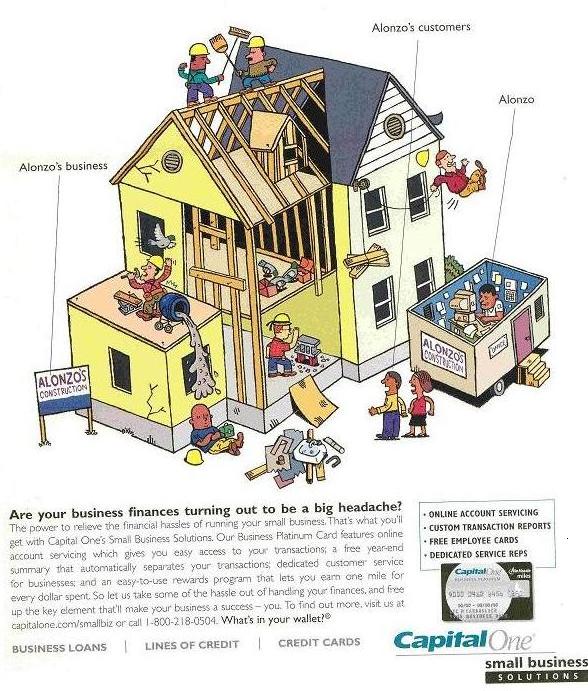
For instance, I believe in headlines. Whether you’re designing an ad or a newspaper page, you need headlines to attract easily distracted readers. If you have a big idea and/or an arresting visual (say, the World Trade Center collapsing), maybe you can get away without a headline. But if your main image is like the one at left, better get a good headline. You need all the help you can get.
The ad at left appeared in the March issue of Fast Company. Capital One is targeting small business owners looking to tame their company finances. So where is the dramatic, benefit-oriented headline? It was deemed expendable, probably because the art director was so tickled with the cartoon.

Here’s the 411. Entrepreneurs want solutions. They don't want cartoons. They don't like cartoons. In my experience (and I once published a Dagwood/Mr. Dithers cartoon on the cover of PROFIT Magazine, but only once), business owners view cartons as kids’ stuff, not serious business. Plus, this is a complex cartoon with no central focus and no caption. Only readers with lots of time on their hands are going to sit down and try to figure out what it all means. When’s the last time you heard a busy entrepreneur say, “I’ve got nothing to do. Think I’ll spend an hour analyzing illustrations in this magazine.”

Worse, anyone who does study this cartoon finds the company being depicted is totally inept, its workers unprofessional at best, and likely suicidal. Few entrepreneurs find anything funny about unprofessional behavior. So if Capital One is expecting its prospects to identify with poor Alonzo, I think they're going to be disappointed.

Below the picture is the “sell” copy. It seems to have nothing to do with the cartoon. “Are your business finances turning out to be a big headache?” Alonzo’s problem is that his workers are building a substandard house and killing each other.

I could see this cartoon possibly working for an ad for a skills-training company, but it has no place in a serious financial ad.

The rest of the copy, about online account servicing, free year-end summaries and a rewards program, is good enough, I guess, but flat and uninteresting. It probably doesn't matter, since any entrepreneurs who stuck around to read the copy are going to find their heads hurting from trying to match the pitch with the cartoon, so they’re unlikely to last till the end.

The call to action? Buried at the tail end of a dense paragraph of low-contrast, hard-to-read body copy. No bold type for the URL, not even a “www” to help it stand out as a Web-based resource. Just a mess.

And don't get me started on the branded “Small Business Solutions” tagline. People with big dreams rarely like to be associated with such a demeaning word. (See my Jan. 10 post, Don’t call them “Small Business”.)

Takeaways: If you’re creating ads aimed at business owners, have a clear message. Help entrepreneurs solve their problems. Use headlines to attract attention. Keep your message simple. Don't monkey around with inappropriate humour (your audience takes itself very seriously). Use simple text devices (boldface, anyone?) to make your key messages stand out.

Note how Capital One put its own tagline [What’s in your wallet?] in bold instead of its key pitch, or its URL or phone number. Selling is about the customer’s needs, not yours.

Thursday, March 23, 2006

Today's Hottest Buttons

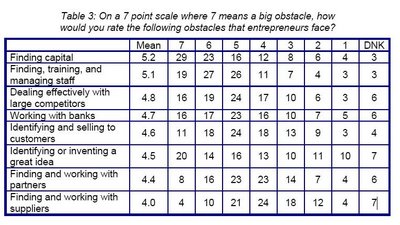
What problems most bedevil Canada’s entrepreneurs? Here are the results of a recent survey of “mid-cap” business owners by COMPAS, for Roynat Capital, conducted in January 2006.


I’m actually surprised to see these entrepreneurs so concerned about financing. This is an issue that seemed to have gone away for a while; certainly, it is no longer the national political issue it was a few years ago.

This looks like a warning to the banks, especially for when they come back to Ottawa for permission to merge. Plus, it’s a sign that all the new private capital now being directed to buyout funds and mezzanine funding isn't getting where it needs to go.

Meanwhile, there’s lots of food for thought here for marketers trying to make entrepreneurs’ lives easier. How can you help them deal more effectively with staff issues (hiring, training, motivating, retaining)?

How can your products or services level the playing field, and enable entrepreneurial firms to compete with bigger organizations?

And how can you help them sell more?

These are the hot buttons your market will respond to.

(You can find the survey summary here. )