That’s the question asked by a reader of this blog after visiting Hewlett-Packard Canada’s website.
As an entrepreneur, he was reading up on printers at HP’s sub-site dedicated to small and medium-sized business. On this page HP offers an ambitious slogan: “No one understands you like HP.”
Well, let’s see.
From the page at http://www.hp.ca/portal/biztown/colour_printing_centre/printing_imaging.php, he clicked on what looked like an interesting link under "Solve Business Problems" called "Success Stories".That click took him to HP’s U.S. site. But what the heck, he figured, a success story is a success story.
Except that the graphic box entitled "Printing solutions success stories for Small & Medium Business" offered this stark message: "None currently available. Please check back."
HP has hundreds of customer success stories on its site. But apparently not one deals with printers in small-business environments. That seems pretty strange when printers and imaging constitute HP’s most profitable division.
What would it take, my correspondent wondered, for HP to talk to a couple of its millions of printer users to see how they’re faring, and post a story or two on its website? “Hell,” said our reader, “they could give me a call.”
What would it take for HP to show its small-biz customers some respect? Especially when it likes to tell business owners that “No one understands you like HP.”
MORAL: If you talk the talk, walk the walk.
Monday, January 30, 2006


Wednesday, January 25, 2006
Entrepreneurship - Act of Faith
Australian entrepreneur Yaro Starak runs several Internet-based businesses, as well as a thoughtful blog at http://www.entrepreneurs-journey.com
He wrote recently about the passion entrepreneurs have for their businesses, comparing it to religious faith. It’s essential reading for anyone who wants to understand how business owners tick. You can read the whole post here, or my condensed version below:
"I have a few friends that I meet with regularly who share my passion for business… For some their business enjoys the majority of their daily headspace, even surpassing the time contemplating sex (yes, these are male friends). Business has become a part of who they are…
Business provides an entrepreneur with purpose. When times are tough faith keeps an entrepreneur working long after other people would have given up. While blind faith is not a good thing, certainly strong faith and courage of conviction are vital for any business person to carry on despite whatever obstacles are thrown at them.
Business provides an entrepreneur with meaning. An enlightened entrepreneur works towards building something that enhances many people’s lives. By creating a business that employs people, provides helpful products or services and creates prosperity for many, the sum effect is an expansion of positivity…
When business people get together they share the faith. Entrepreneurs discuss commerce, opportunities and advise each other on the best course of action in a given situation. It’s as if there are a set of rules, some written, some intuitively understood that are guiding these people. When entrepreneurs network they call on their collective understanding and knowledge to help each other and create something greater than the sum of the parts. It’s as if they are divinely inspired."
I think Yaro's right about how entrepreneurs getting together and discussing commerce is really an act of shared faith.
The best entrepreneurs I know are extremely generous about sharing ideas, connections and resources with fellow keepers of the flame. I think they see society as a closed loop. By helping you they believe they are helping themselves by supporting the greater ecosystem – even if they never see you again.
Of course, the other reason they help each other is because they don't believe anyone else will.
Which is a huge opportunity for marketers who understand it.
Friday, January 20, 2006
Questions every business owner should ask
Bank of Montreal is one of the smarter banks in using its website to provide useful, easily accessible information for business owners. (It’s not very well structured or promoted, but you can’t have everything.)
Worried perhaps that some of their clients are sleeping at night, BMO offers a long list of questions that entrepreneurs in growing businesses should be asking themselves. It’s also a useful checklist for anyone who sells to small business, to help them better understand their customers’ needs.
Questions for the owner of a growing business
You are in business and making a profit. Orders are coming in and you are considering expanding your product line or adding a new location. Keeping an eye on the fundamentals - cash management, your competition and managing staff and expectations - can help sustain your expansion for the long run.
Questions to Ask Yourself
Do I have the necessary capital to finance my growth?
Am I doing everything I can to keep a healthy balance of work and personal life?
Do I know what the competition is doing?
How will the competition react?
Am I expanding too quickly?
Can I handle the stress of managing a much larger business?
Do I want to grow for growth's sake or because it will be more profitable?
Things to Watch For
Staffing up too quickly
Accounts receivable that are not being collected
Increased inventory costs
Expansion without a solid capital base
Overworked staff
Organization growing out of control
Inefficient Cash flow management
Keys to Survival
Follow your Business Plan
Keep your financial partners informed of any major expansion or change
Expand in areas where you have experience and can make a profit
Listen to your customers and adjust your approach
Delegate more
Have proper control systems in place to manage growth
To find this checklist and more like it, click the link below. Once you're there, go to the right-hand menu and click on “Business Planning Resources.” Take your time – there's lots of good stuff here.
Click here for BMO’s Business Planning Resources
Wednesday, January 18, 2006
Know Your Market

Anyone know what Sony is doing in this VAIO personal notebook ad, which ran in a recent issue of PROFIT Magazine?
Don’t get me wrong. This is a must-have machine, a fully functional notebook that almost fits in your pocket. But I’m disturbed by the claim that this little beauty will “keep you productive and entertained at home in the office or on the road.” (BTW, doesn’t Sony believe in commas?)
I know why an ad targeting small business stresses productivity. But entertainment? Maybe Sony thinks businesspeople by day become cinephiles at night. In the tight white type, Sony claims that the 10” LCD display and unique compact design “deliver a movie-viewing experience like no other computer.”
Sorry, friends. My experience tells me entrepreneurs don’t watch DVDs when they’re travelling. They barely watch TV at all. On the road, the entrepreneurs I know catch up on work after dinner, watch the news and go to bed so they can get up early, finish the job and go home. The last thing they’re gonna do is waste two hours watching a movie – especially on a compact screen. Why do you think they bought their $5,000 home theatre?
And let’s face it: if you want to burn DVDs, you’ll do it on a desktop computer or an ordinary 14” laptop. You could buy both machines for far less than the $2500 pricetag of this VAIO.
Why don’t Sony and its agency play up the true value of this product – its sexy design and extreme portability? This machine turns heads. It fits in your briefcase. It’s thinner than my cellphone. It’s easy to work with in tight spaces. It’s the smallest, best looking and hardest-working notebook on the market.
It says you’re a player.
Not a watcher.
Tuesday, January 17, 2006
Everybody Wins!
Special thanks to marketing expert George Torok for promoting this blog over on his new blog the other day. He's one of the few gurus who doesn't promise a simple aswer to every marketing problem - so he knows the importance of understanding segmented markets.
He even got a good quote out of me about why I set up Selling to Small Business. "When the banks, tech firms and service providers better understand business owners," he says, "they are much more likely to offer products and services that entrepreneurs need, at a price they can afford. So everybody wins!"
I couldn't have said it better myself! Thanks, George.
Friday, January 13, 2006
Key Small Business Insight No. 2: The Truth about Growth
The “small business market” is a deceptively simple name for a huge, sprawling non-collective that in Canada covers everything from farmers and fishers to dry cleaners, consultants, landscape architects, sophisticated equipment exporters and software developers.
There’s not much shared experience, and no consistent self-image. Their most common needs are those we all have simply as people: to keep food on the table, to be respected, to make more money, to cut costs, to make our lives easier. This is a major reason why B2SB (business to small business) marketing has as much in common with B2C (business to consumer) as with B2B. (The other main reason, of course, is that you are asking them to spend their own money, not someone else’s.)
But there’s one thing all businesses have in common, right? They all want to grow?
Wrong. Research (by Barb Orser and Rena Blatt) has found that half of small business owners don't want their businesses to grow at all.
For many, it’s a lifestyle issue – they’re happy with things as they are. They’re making enough money, they don’t want to work harder. And they certainly don’t need the headaches (longer hours, hiring new people, opening new locations and supervising people at a distance) that come with success.
That doesn’t mean you shouldn’t market to growth-oriented companies – after all, they're 50% of the market, and they're the ones mostly likely to buy your business solutions. But if you are going after the whole market, do keep in mind that growth is not always a positive. And success is not always a matter of size.
Wednesday, January 11, 2006
Separating Entrepreneurs from Employees
As part of a column I do for MoneySense Magazine, I was talking to a financial planner the other day who specializes in serving business owners. He says he's spotted an intriguing difference between entrepreneurs and employees.
An employee's greatest fear, he says, is not receiving a cheque every week.
An entrepreneur's greatest fear, by contrast, is having just one source controlling their paycheque.
So are entrepreneurs risk-oriented -- or risk-averse?
(Leave a comment, if you're not comment-averse.)
An employee's greatest fear, he says, is not receiving a cheque every week.
An entrepreneur's greatest fear, by contrast, is having just one source controlling their paycheque.
So are entrepreneurs risk-oriented -- or risk-averse?
(Leave a comment, if you're not comment-averse.)
Tuesday, January 10, 2006
Key Small Business Insight No. 1: Don’t call them “Small Business”
Yes, this blog is called “Selling to Small Business.” That’s because it is not designed for small business.
To marketers, ‘small business’ is a useful name for a market segment. But just as you would not address a “Single White Male” (another perfectly useful marketing descriptor) as “Single White Male,” I urge you to avoid using the phrase “small business” when talking to entrepreneurs.
(I hardly ever use the phrase on my other blog, Canadian Entrepreneur. Because small-business owners read it.)
Years ago, when I joined PROFIT Magazine, it was called, er, Small Business Magazine. That name did a great job of describing our market niche – but it was a name many readers shunned. In English, the word “small” is a pejorative. It often means “inconsequential.” We talk about “small talk” (idle, meaningless chitchat). “Small potatoes, small beer, small-town thinking…” are all negative concepts.
If you think about the work it takes to build even a three- or four-person business, you may understand the resentment many business owners feel when you call their company “small.”
At, um, Small Business magazine, we held focus groups and learned that some readers didn’t mind the name, but most did. One owner said he hid the magazine inside the pages of another magazine, so none of his employees could see him reading something called “Small” Business. Another attendee summed it up perfectly: “A small business is any business that’s smaller than my business.”
When you call a business ‘small,” you are (probably unconsciously) judging it. Sure, it's small compared to the banks, Alcan or Loblaws. But judged by its own markets and aspirations, it's not small. I remember meeting a guy who talked about running "the third-largest steel fabricator in the Ottawa Valley.” By most national standards it’s a small business – but not in his eyes. He’s a significant player in his markets.
Marketing 101 says you must view the world through your customers’ eyes. Please toss the word “small business” out of your copywriting vocabulary.
What’s wrong with the word “business?” (Or “business owner,” if you’re getting personal?) 98% of businesses are small and medium-sized businesses – so they’re the norm, not Air Canada, Bombardier or Chrysler.
Saturday, January 07, 2006
"That was hard"
I hate to pick on Staples again (see previous post, "Staples Stumbles"), but I had an experience yesterday that suggests they are seriously out of touch with their market.
My laptop computer has had a minor malfunction since I got it from Staples Business Depot six months ago. Yesterday, having a rare hour of free time and not foreseeing a need for the laptop for a week or two, I decided to take it back to the store to get it looked at.
Silly me. It was Saturday. Their tech guy isn’t in the store on Saturday. (Too bad they didn’t tell the first customer service rep I talked to, since she tried twice to page a tech person for me before I was told there wasn’t one on site. “But it’s the busiest day for retail,” I argued. I got a shrug. “A store that sells so much technology only has one tech guy?” I asked. Another shrug.
Well, when is he on site? Monday through Friday, from store open till, oh, about 5. “Don’t they know that’s exactly when your customer base is busy working?” I asked. Shrug again.
So if you need tech support from Staples (open seven days a week, and till 9 pm on evenings), entrepreneurs be warned: you’ll have to take time away from your customers, employees and prospects. Smart, huh?
It wouldn’t be so bad if Staples weren’t pushing the slogan, “That was easy.” Their perverse tech support policy doesn’t make anything easy. Next time they ask for my business – shrug.
TODAY’S TIP: Be available to your customers when it's convenient for them.
You wouldn’t think we’d have to say it, would you?
Thursday, January 05, 2006
Sleepless in Small Business
What, I hear you asking, stresses entrepreneurs most? Is it the banks, government regulation, high taxes, or that underperforming sales manager in Tucson?
Last year, international consultants Grant Thornton polled more than 6,000 CEOs in 24 countries to find out what keeps them awake at night. Here are their 10 biggest sources of stress:
Increasing competition: 43%
Economic environment: 38%
Cash flow/pressure on profit margins: 37%
Regulation/red tape: 36%
Not enough time with family/friends: 32%
Shortage of leisure time: 32%
Keeping up with technical developments: 24%
Change in audit requirements: 23%
High volume of e-mail: 21%
Wealth and how it's tied to the business: 20%
Stress Factor No. 11 is also worth noting: relations with partners and shareholders (19%).
So what do you do with this information? You’re in great shape if your products or services give businesses an edge on the competition or insulate them from economic swings. If you can help them boost profits or master technology, you’re in like Flint.
Plus, focus on how you can save business owners time. For many, that's a scarcer resource than money.
And think twice before trying to sell them on e-mail-based services. They already have more than they can handle.
(Canadian entrepreneurs, by the way, ranked middle of the pack in terms of stress levels. Most stressed were business owners in Turkey, Poland and Russia [wonder why?]. Least stressed: Netherlands, Italy, France and the UK.)
But the stress-free life isn’t always best: Canadians ranked near the top (and well above the above nationalities) in terms of their outlook for their country’s economy over the next 12 months.
Monday, January 02, 2006
Guess who owns SmallBusiness.ca
It’s time I started praising B2SB marketers who are doing a good job of marketing to business owners. So kudos to BDO Dunwoody.
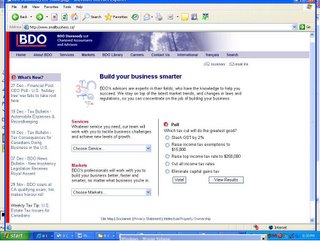
Today I wondered who owns “smallbusiness.ca”. When I typed the URL into my browser, up popped the home page of small-business accounting firm BDO Dunwoody Canada. It looks like they registered the name in October 2000 (back when most organizations could only get one dot-ca registration each), so good on them for clearly communicating their market positioning over the long term.
But why, I wonder, don’t they make something more of this?
When you type in http://www.smallbusiness.ca/, you come to the same home page you would if you’d typed “www.bdo.ca.” There’s nothing special to explain why BDO secured the smallbusiness.ca address. There’s nothing that addresses the likelihood that whoever lands on this page wasn’t looking for an accounting firm.
Why not give visitors a landing page worthy of the initiative they’ve shown? Congratulate them on their cleverness in finding BDO, since the firm is so committed to the small-business market, and its website contains so many useful features for entrepreneurs. Then help users find them.
And then, in case BDO doesn’t have what the visitor is looking for, why wouldn’t they offer “Other Links” to alternative Canadian small-business resources? There’s About.com’s small business section, Strategis, PROFIT or Canadian Business magazines, the Globe’s Report on Small Business section, the CFIB, Enterprise Magazine, the Canada Business Service Centres, CanadaOne – and so on.
Business owners are always looking for an edge. Connect them to a useful resource they didn’t know about before, and they’ll be your friend for life. Or at least a few weeks.
BDO took a visionary step in securing the smallbusiness.ca address. Now it needs to show some imagination to prove that vision was no fluke.
Today I wondered who owns “smallbusiness.ca”. When I typed the URL into my browser, up popped the home page of small-business accounting firm BDO Dunwoody Canada. It looks like they registered the name in October 2000 (back when most organizations could only get one dot-ca registration each), so good on them for clearly communicating their market positioning over the long term.

But why, I wonder, don’t they make something more of this?
When you type in http://www.smallbusiness.ca/, you come to the same home page you would if you’d typed “www.bdo.ca.” There’s nothing special to explain why BDO secured the smallbusiness.ca address. There’s nothing that addresses the likelihood that whoever lands on this page wasn’t looking for an accounting firm.
Why not give visitors a landing page worthy of the initiative they’ve shown? Congratulate them on their cleverness in finding BDO, since the firm is so committed to the small-business market, and its website contains so many useful features for entrepreneurs. Then help users find them.
And then, in case BDO doesn’t have what the visitor is looking for, why wouldn’t they offer “Other Links” to alternative Canadian small-business resources? There’s About.com’s small business section, Strategis, PROFIT or Canadian Business magazines, the Globe’s Report on Small Business section, the CFIB, Enterprise Magazine, the Canada Business Service Centres, CanadaOne – and so on.
Business owners are always looking for an edge. Connect them to a useful resource they didn’t know about before, and they’ll be your friend for life. Or at least a few weeks.
BDO took a visionary step in securing the smallbusiness.ca address. Now it needs to show some imagination to prove that vision was no fluke.
Sunday, January 01, 2006
Staples stumbles
Make no mistake: In future I will be praising companies for good examples of marketing to small business.
But in the meantime, justice demands that we excoriate Staples/Business Depot today.
I'm on their e-mailing list, and I just received an e-mail to fill out a survey on purchasing business forms. My initial thought was "Good for them." Taking time to research your target market is a sign of interest, openness and respect that many small business owners will appreciate.
Then I read the first question.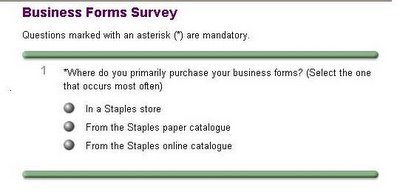
But in the meantime, justice demands that we excoriate Staples/Business Depot today.
I'm on their e-mailing list, and I just received an e-mail to fill out a survey on purchasing business forms. My initial thought was "Good for them." Taking time to research your target market is a sign of interest, openness and respect that many small business owners will appreciate.
Then I read the first question.
Where do you buy your business forms? Staples, Staples or Staples?
That does not strike me as a sign of interest or respect. It suggests an unearned sense of entitlement or arrogance - and is guaranteed to annoy or frustrate any customer or prospect who doesn't solely patronize Staples. Why not offer the customer a chance to cite other sources -- especially since there are so many software alternatives that eliminate the need for most preprinted forms?
I bet a lot of customers will abandon the survey right there. At question 1.
That same inflexibility occurs throughout the survey. At several points, the survey asks if you would buy a product if it was similar to your favorite brand at the same price, or if it cost a little more, or if it was a better product. Your choices are "yes" or "no." There's no "maybe" to reflect the complexity of the purchasing process and the variables involved in the decision. (Maybe it's another brand name I'll recognize? Maybe its packaging will look like crap. How can I know if I will buy it based on the vague information you've given me?)
At the end, Staples does a good thing. It offers a chance at a $500 gift card for people who divulge personal information. Building (or filling out) lists is always good. But Staples doesn't say what it will do with the info, thereby restricting what it can do in future.
Then the very last screen on the survey gives the game away. The host of the survey software, Zoomerang, offers you the chance to send your own free survey. It's possible that Staples is paying to conduct this survey, but it sure doesn't look that way. We all know retail margins are tight, but I think most customers expect national retail chains to operate on a more professional plane than Bob's Home Business.
Lessons learned? Honour your prospects. Make your research about their world, not yours. Make your questions reflect their behavior, not your needs. Offer more options, not fewer. And use professional tools that reflect your stature in the marketplace.
Every customer contact counts.
Friday, December 30, 2005
Amex finds entrepreneurs happy in their work -- but not much more
An interesting press release came out of American Express Canada five days before Christmas.
(That, by the way, is a good time to publish a news release if it’s not newsworthy. If it’s important, you might prefer to release it at a time when the intended audience is likely to notice it.)
Amex interviewed 500 entrepreneurs across the country in a “state of small business” survey. I couldn’t see any new information, but some decent insights for those trying to understand this market.
The main conclusion: Entrepreneurs work more than 55 hours a week, they spend weekends catching up on paperwork, they take minimal vacation time and endure severe stress. Yet they wouldn't trade what they do for a steadier (and probably easier) job working for someone else.
“Even dealing with daily problems and obstacles like staffing and employee issues brings its own set of rewards as they see it being part of the process of creating something worthwhile for themselves and their family.”
What Motivates Them?
"Sitting back and watching the world go by isn't part of a small business owner's make-up, says Donna Lue-Atkinson, Amex’s Director of Small Business Services. “These Canadians are squeezing more out of life than just the day-to-day routine. They've taken a passion for an interest or idea and turned it into a rewarding venture."
While some say they started their own business to strike it rich (28%), most are strongly inspired by internal drivers like pride of achievement and personal satisfaction (87%). They say the reward for all their worries and hard work is rooted in being able to make a living doing something that gets them charged every day.
Only 8% said they started their own business because they were out of work (8%). In contrast, 83% said they have valuable skills that can be put to better use if they're calling the shots rather than taking orders from someone else.”
"Lonely and Isolated"
Amex’s research confirmed my theory that many business owners feel lonely and isolated -- "especially in the early days as many make the adjustment from a busy corporate environment to being the only one on the work site or in the office. Generally, it isn't until a few years after start-up that they have the money and resources to have regular staff on the payroll."
This is a key point for marketers to understand. The camaraderie that many managers and executives find at work is not shared by many entrepreneurs – who have no peers in their organization, and rarely have time to pursue professional development outside of work.
For outstanding entrepreneurs, organizations such as YPO have always made a difference – but only a small percentage of business owners ever get involved in such peer-based information sharing.
"Small business owners are definitely saying this isn't a road for the faint of heart," says Lue-Atkinson. "Particularly, their experiences are very different compared to those who have the relative security of corporate life to fall back on - we know we'll have a pay cheque at the end of the week, draw a pension when we retire and have a health package if we get sick. Small business owners don't have the same safety net. Because of that, they're a very unique market in terms of their motivators and needs."
A few notes on Amex’s release: It’s hard to find it on their website. They certainly didn’t post it in their “small business” section (which is all about their credit cards). You have to go into the Site Map, which is called “Site Help”, and click on “Latest News,” which takes you to a Canada Newswire mini-site. Even then, all you get is the press release, which doesn't contain much more information than I've summed up here. There’s no background stats for those who want more information, and nothing about what this adds up to.
Presumably the marketers at Amex got other information for their own use out of the survey – but they offer no hint how they are using these insights to serve small business better.
Which may be why they dumped it into the marketplace on the 20th of December.
Friday, December 23, 2005
Seven Simple Rules
For your holiday treat, here’s a fun look at selling to small biz.
The source: PROFIT Magazine’s back-page humour column, which chronicles the adventures and opinions of archetypal entrepreneur Cumulo Nimbus (sort of the Bob Newhart of small business owners).
In June 2005, Cumulo offered Seven Simple Rules for Selling to Small Business. Some are more serious than others, but he makes good points that all marketers should keep in mind.
Here are Cumulo’s Seven Rules.
* Don't call us "Small Business." No matter what the stats say, my business is not small — it's the third largest manufacturer in our industry in the entire city of Slug Flats. A small business is the guy who prowls our neighbourhood with his pickup, offering to take down old TV antennas for cash.
* Never call us "SMBs" or "SMEs" (at least not to our faces). You say that it means small and medium-sized businesses or enterprises. I say it sounds like you're selling to a Smurf.
* If you're selling technology, don't drown me in jargon. Every time I buy a computer, all I hear is chipsets and megs and RAMs till I'm Big Blue in the face. Why not just tell me what this model can do that the others can't? Tell me how this technology makes life easier for me.
* Don't talk down to me. Just because I don't understand your new product doesn't make me an idiot. (The way your reps explain things, I'm not sure they understand it either.)
* Ask me how often I want to hear from you. So you've renamed one of your products and painted it blue; that doesn't mean I want to know about it.
* Give me experts I can talk to. I don't care if your call centre is in Moncton or Mumbai, so long as they can really help me.
* Don't make me feel like a deadbeat if I ask for a lower price. When business owners spend money, there's a reason they treat it like it's their own.
If you enjoy print-based business sitcoms (and who doesn’t?), you can peruse other Cumulo columns here.
Happy holidays!
Thursday, December 22, 2005
“I’ll be rude if I have to be” -- Inside the entrepreneurial mind
The most precious thing any entrepreneur has (or sells) is time. So if you wonder why I am always arguing for clear, impactful messages when communicating with entrepreneurs, it’s because these busy business owners will only give you seconds to make your point. If you haven’t sold them at a glance, you’re done.
So here’s Exhibit A.
Bob Parsons is a U.S. entrepreneur who founded fast-growing Internet Net registry GoDaddy.com. In a recent post on his blog (Nov. 17), he wrote about the constant need to protect his time against “all sorts of ‘time grabbers’ that vie for our attention.”

Here (condensed for your convenience) are a few of his “not so polite” time-saving tips.
* "If a stranger calls me they better get right to the point. “I insist that if someone is calling me and I don’t know them, that they immediately get to the point with what they want. If I have someone on the line and they start rambling and simply talking about who they are, I will chime in that they have 30 seconds to get to the point. If they don’t immediately get to the point, I hang up.
* Once they get to the point, if it’s something I’m not interested in, I will simply say, “I’m not interested,” and immediately hang up.”
* If the person on the other line does not have something of immediate interest to you, you owe them nothing.
* I particularly dislike calls from boiler rooms promoting bad investments.Often, I will simply hang up on these without saying anything. Other times I simply say – before hanging up — “when I’m ready to trust my money to a complete stranger, I’ll give you a call.”
* Hanging up quickly allows you to avoid time-wasting calls. The most important thing to remember is to say you can’t help, be polite, say you have to go and then hang up.
* Do not allow yourself to get drawn into listening to an endless stream of dialogue that doesn’t interest you… Sitting there listening won’t get your job done.
* When customers call, they are doing me a favor. By calling me the customers are giving me inside information as to what might be wrong with my business, and letting me know what I can do to make it better. So I always pay attention to these calls.
* If someone wants me to return a call, I've got to know what they want. If someone just leaves a name and phone number and I don’t know who they are and what they want, I will never return the phone call.
*For me to return any call, the message has to be understandable, it has to be of immediate interest to me and it has to be something that I want.
* Email is another place where you can save a bundle of time. I expect any email I open to be both brief and to the point. If it's not both, unless it deals with a subject that interests me, I immediately hit the delete key.
* Some of the things I appreciate are subject lines that give me an idea what the email is about, formatted paragraphs of two to four short sentences — nothing wastes more time than trying to decipher a huge unformatted blob of text — and no more than a screen of text. Basically if an email needs more than 5 to 10 seconds of my time it gets deleted mostly unread.
* It's really all about taking charge of your schedule. Some readers after going through this article will think I’m rude. I understand that. When it comes to protecting my time I like to be polite, but it’s not a requirement for me – I’ll be rude if I have to be.
* All of us need to be jealous of our time – we have so little of it. If protecting my time means being short and to the point, then so be it. It will be me who enjoys the extra time I have available later. I will have earned it."
Rick's Note: I like the forceful language of entitlement that Bob uses. “It’s all about me.” “I’ve earned it.” A lot of people may be uncomfortable sounding like that, but I find this attitude reflects that of a lot of successful entrepreneurs.
Ignore it at your peril.
So here’s Exhibit A.
Bob Parsons is a U.S. entrepreneur who founded fast-growing Internet Net registry GoDaddy.com. In a recent post on his blog (Nov. 17), he wrote about the constant need to protect his time against “all sorts of ‘time grabbers’ that vie for our attention.”
Here (condensed for your convenience) are a few of his “not so polite” time-saving tips.
* "If a stranger calls me they better get right to the point. “I insist that if someone is calling me and I don’t know them, that they immediately get to the point with what they want. If I have someone on the line and they start rambling and simply talking about who they are, I will chime in that they have 30 seconds to get to the point. If they don’t immediately get to the point, I hang up.
* Once they get to the point, if it’s something I’m not interested in, I will simply say, “I’m not interested,” and immediately hang up.”
* If the person on the other line does not have something of immediate interest to you, you owe them nothing.
* I particularly dislike calls from boiler rooms promoting bad investments.Often, I will simply hang up on these without saying anything. Other times I simply say – before hanging up — “when I’m ready to trust my money to a complete stranger, I’ll give you a call.”
* Hanging up quickly allows you to avoid time-wasting calls. The most important thing to remember is to say you can’t help, be polite, say you have to go and then hang up.
* Do not allow yourself to get drawn into listening to an endless stream of dialogue that doesn’t interest you… Sitting there listening won’t get your job done.
* When customers call, they are doing me a favor. By calling me the customers are giving me inside information as to what might be wrong with my business, and letting me know what I can do to make it better. So I always pay attention to these calls.
* If someone wants me to return a call, I've got to know what they want. If someone just leaves a name and phone number and I don’t know who they are and what they want, I will never return the phone call.
*For me to return any call, the message has to be understandable, it has to be of immediate interest to me and it has to be something that I want.
* Email is another place where you can save a bundle of time. I expect any email I open to be both brief and to the point. If it's not both, unless it deals with a subject that interests me, I immediately hit the delete key.
* Some of the things I appreciate are subject lines that give me an idea what the email is about, formatted paragraphs of two to four short sentences — nothing wastes more time than trying to decipher a huge unformatted blob of text — and no more than a screen of text. Basically if an email needs more than 5 to 10 seconds of my time it gets deleted mostly unread.
* It's really all about taking charge of your schedule. Some readers after going through this article will think I’m rude. I understand that. When it comes to protecting my time I like to be polite, but it’s not a requirement for me – I’ll be rude if I have to be.
* All of us need to be jealous of our time – we have so little of it. If protecting my time means being short and to the point, then so be it. It will be me who enjoys the extra time I have available later. I will have earned it."
Rick's Note: I like the forceful language of entitlement that Bob uses. “It’s all about me.” “I’ve earned it.” A lot of people may be uncomfortable sounding like that, but I find this attitude reflects that of a lot of successful entrepreneurs.
Ignore it at your peril.
Tuesday, December 20, 2005
What makes entrepreneurs tick?
To sell to business owners, you need to know what makes them tick.
Fortunately, Canada's major banks love to survey small business and share the results in order to prove how "in touch" they are.
Here are some of the results of a recent RBC survey that found that women entrepreneurs are often motivated less by money and more by personal priorities.
"Canadian women are starting more businesses than ever before, but for a majority of Canada's current and aspiring women entrepreneurs, the desire to own their own business may be less about the money and more about personal priorities.
"According to an RBC survey conducted by Ipsos-Reid, while 36% of men planning to open a business plan to do so to become wealthy, only 23%of women planning to open a business do so for the same reason. As well, access to a more flexible working schedule is a greater motivator for women entrepreneurs (63%) than men (51%).
"However, the majority of women and men entrepreneurs (69% and 64% respectively) seem to be equally driven by a love for what they do or hope to do.
"Women in Canada are turning to self-employment and pursuing their career dreams at unprecedented levels," said Kris Depencier, RBC Royal Bank's national manager, Small Business. "Since 1981 the number of women entrepreneurs has increased by over 200%. For a large portion of these women, building a business is not only a labour of love, but also a way to balance work and family obligations."
Thursday, December 15, 2005
The first lesson of marketing
The first lesson you learn in marketing should be that nobody cares about you or what you sell.
If you want someone to pay attention to you, you have to earn their attention -- and then maybe later their respect.
It's amazing to me how many marketers don't get it. They think that if they advertise a product or a URL, prospects are going to eagerly devour every word, or flock to their website to learn all they can.
Things don't work that way. Not because people don't like you, but because they are too busy.
Researchers claim people today are bombarded with 3,000 advertising messages a day. How many, honestly, do you have time to proactively explore?
OK, every marketer will say they already know that. So why don't they act that way?
Why do we continue to see ads with reverse type (which actively discourages reading)? Why do so many advertisers talk on and on about themselves and not the needs of their customers? How do they expect prospects to read 400 words of copy on a page when they haven't yet established a value proposition?
These are general observations that apply to any market. But the entrepreneurial market doubles this challenge.
These are the most distracted, time-short people you'll ever know. They have disciplined themselves to always get to the point. And they have zilch respect for people who don't understand the importance of their time.
The rules of communication are clear. Show that you understand your market before seeking to be understood.
Wednesday, December 14, 2005
What Women Entrepreneurs Want
Reprinted from my Canadian Entrepreneur blog,
Nov. 07, 2005
To sell to a specific market, you need to understand those people's needs. To help smallbiz marketers understand the problems facing entrepreneurs, here's a column I wrote last month about the problems discussed by some of Canada's top women business owners.
Today I moderated a roundtable discussion among seven distinguished women entrepreneurs. They all rank on PROFIT’s 2005 list of Canada’s Top Women Entrepreneurs, and were tremendously successful and articulate.
Nonetheless, the goal at the W100 Idea Exchange, held at the Vaughan Estate in Toronto, was to discuss the challenges these entrepreneurs are currently facing. Graciously, they each came up with one or two.
Here’s a sampling of the issues they are facing, and the solutions offered by their peers.
1. One business owner asked for help improving the margins in her business. Suggestions included raising prices, hiring consultants to cut costs, and selling the company’s real-estate assets. When the entrepreneur said she was reluctant to raise prices, another participant said her company raised prices 15% last year. When it received no complaints, it raised them again.
2. One participant complained about the high cost of buying custom end-to-end management software. Several entrepreneurs said they had found it cheaper to hire their own IT staff to produce home-made solutions where the mass-market packages leave off. Another said she actually asks competitors for advice on topics like this, as they understand her needs best.
3. “I need help finding, contracting and keeping sales people,” said another entrepreneur. “’Good sales people’ is becoming an oxymoron.”
Among the suggestions from the table: Ask more process-oriented questions in the interview to better understand a sales candidate’s abilities and experience; revise commission structures to better reward desired behaviour; offer better training to encourage good people to stay; hire two or three salespeople at a time to reduce training costs and hope that at least one makes the grade.
4. One entrepreneur said her business is ‘plateauing,’ and competitors are eating into her margins. What should she do? Did she need an exit strategy?
One peer picked up on the real problem: “Are you bored with the business?” The table offered several solutions, such as delegating the parts of her job she doesn’t like, or investing in new startups to give her the growth fix she seems to crave. She seemed pretty happy with the feedback.
For more on PROFIT’s W100 list, click here.
How NOT to market to small business
Strange “special feature” in yesterday’s National Post [Nov. 21]. Roynat Capital took out an ad that wrapped around the business section to salute the winners of the Ernst & Young Entrepreneur of the Year awards program.
Instead of telling us anything intelligent about the winners, this 1.5-page supplement showed us black-tie pictures of some of the winners and their spouses – along with a lot of sponsors (the publisher of the National Post got in there somehow).
The pictures were taken at the unveiling event, held in Ottawa, um, Nov. 3. The text identified the various winners, but actually spent more time talking up the sponsors (look! there’s the publisher of the Post again!).
So here are my questions:
Why is Roynat paying to promote the National Post and Ernst & Young?
Why were the entrepreneurs short-changed in an ad that was supposedly a tribute to them?
Why did it take so long (nearly three weeks!) to recognize these winners?
Why is there nothing in this ad addressing the needs of Roynat’s customers?
And why is this newsprint wraparound called “Special Feature to National Post / Presented by Roynat Capital” instead of just being called an ad?
I have nothing against Roynat. In fact, I appreciate that it is one of the most aggressive supporters of small business in the Canadian marketplace. I just don’t understand why it pisses so much advertising money down the drain.
This “feature” ends with a full-page Roynat ad much like those it has been running every week in the Post. These ads showcase boring, nearly unreadable profiles of supposedly interesting Canadian companies. I actually complained about these ads recently to a Roynat exec, because I think they are the exact antithesis of anything that will help, inform or impress an entrepreneur.
To get entrepreneurs to read this profile, it should be short and punchy, with lots of color and personality, and end with the entrepreneur’s best experience and advice. Entrepreneurs don’t care about your company, they want to know what you know that can help them.
Instead, Roynat runs a 900-word profile, with lots of unnecessary history and product detail. No subheads, no boldface, no sidebars to break up the tedious columns of copy. And no advice, no lessons. Which means this is all about him (the profiled entrepreneur), and not about you (the person reading the ad). Which makes for bad advertising, no matter how much they spend.
The executive agreed with me. But he wasn’t in marketing, so he wasn’t about to rock the boat.
Originally printed in Canadian Entrepreneur, Nov. 22, 2005
This post generated one Comment:
Donna Papacosta said...
Amen, Rick! It's amazing how many companies waste their money on piffle like this.For the sake of small biz everywhere, I hope they listen to you. ;-)
Tuesday, December 13, 2005
The Growing Clout of Small Business
There are encouraging signs that entrepreneurship is on the march again.
In good times, everyone gets excited about working on Bay Street or going to work for big companies. But when shocks appear – and this summer’s oil price spike was an 8.8 on the Richter scale of business confidence – people get nervous about the prospects for big, dumb corporations, and they look again to the opportunity and security afforded by small business.
A few weeks ago, RBC Financial produced a survey that found more than a million Canadians are thinking of starting up a new business.
At the same time, a Scotiabank survey found 90% of Canadian entrepreneurs believe their business will perform as well or better one year from now than it does today. "It's encouraging to the business community on the whole that small business owners are generally enthusiastic about the potential for increased earnings," noted Diane Giard, Scotia’s VP of small business banking.
A CIBC World Markets study estimates 80,000 Canadians will become small business owners this year, swelling the national total to 2.5 million. Even better, says CIBC, "nearly one in four Canadians say they will be self-employed at some point in the next five years."
And today, I got an e-newsletter from VISA promoting discounts for small business (itself an indicator of the market’s clout) – and several articles geared to entrepreneurs (altho’ they’re a bit dull).
In one story, writer Chuck Davies quotes CFIB economist Ted Mallett musing about the positive forces behind today's startups."We know that two thirds to three quarters of people who enter self-employment do so for positive reasons, they go in with their eyes wide open. It's part of their plan,” says Mallett. “The rest do it because they're forced into it, either because they haven't been able to find paid employment opportunities or because they've been laid off or downsized."
Mallett also notes suppliers’ growing interest in the small-business market. "Banks and financial institutions have realized that small business owners are a very profitable segment for them. A startup may not have much to go on, but the fact that the person starting it up is 45 years old, has finished a mid-level career, has a nice amount of equity in their home, is driven and has a good credit record – this person is going to be very profitable for a bank if treated right."
Mallett sees other suppliers joining the trend. In particular, providers of information technology are starting to realize “they've got to target a class of business that's considerably smaller than the ones they've been used to dealing with," he says. "That means their solutions and their pricing models have to be different."
In fact, yesterday the Globe ran an article saying more telecom firms are viewing small business as a market segment worthy of its own products and dedicated strategies. This isn’t new (anyone remember BellZinc.com?) – but it seems a broader initiative than we’ve seen before.
In future posts, we'll see how they do.
Subscribe to:
Posts (Atom)


